Air Pollution Policies foR Assessment of Integrated Strategies At regional and Local scales
APPRAISAL (Air Pollution Policies foR Assessment of Integrated Strategies At Regional and Local Scales) is part of the European Union’s Seventh Framework Programme (FP7). The project aims to evaluate the strengths and weaknesses of the different methodologies adopted by Member States for air quality assessment and monitoring, and to identify possible strategies for improving these methodologies. It also seeks to define guidelines to optimise such approaches and criteria to measure their effectiveness, ensuring consistency and comparability across different national assessment frameworks.
The project is set within a European context characterised by widespread exceedances of air quality limit values, particularly for pollutants such as particulate matter (PM), nitrogen oxides (NOX), and ozone (O3), making a more effective evaluation of emission reduction policies necessary, especially in areas with high population density and complex emission sources.
| Project: APPRAISAL – Air Pollution Policies foR Assessment of Integrated Strategies At regional and Local scales Tipo di progetto: EUROPEAN FP7 308395 Budget: 2’301’010 Euros Durata: 2012 – 2015 Number and Partners involved: 14 project partnerz; University of Brescia with Politecnico of Milan (IT), TerrAria (IT), JRC – Joint Research Centre (IT), Systems Research Institute Of The Polish Academy Of Sciences Ibs Pan (PL), Aristotelio Panepistimio Thessalonikis (GR), Universite Libre De Bruxelles (BE), Centre National De La Recherche Scientifique (FR), Universidade De Aveiro (PT), Barcelona Supercomputing Center – Centro Nacional De Supercomputacion (SP), Institut National De L Environnement Et Des Risques INERIS (FR), Vlaamse Instelling Voor Technologisch Onderzoek n.v. (BE), Centro se Investigaciones Energeticas, Medioambientales y Tecnologicas-Ciemat (SP), The Finnish Environment Institute – SYKE (FL), Les White Ass.Ld. (UK). Role: Partner |
 |
APPRAISAL aims to provide technical and scientific support to policymakers in the field of air quality through the development of guidelines. The project was structured in two main phases each addressing complementary aspects of the assessment framework.
During the first phase, a comprehensive and systematic review of air quality and health impact assessment methodologies was carried out across European countries. These approaches were critically analysed in terms of their underlying assumptions, input data requirements, spatial and temporal resolution, and applicability to different policy contexts. In parallel, the potential implementation of Integrated Assessment Modelling (IAM) tools was evaluated.
This phase also led to the identification of key areas for research and innovation, along with the main stakeholders to be involved.
In this phase, a systematic review of modelling approaches adopted across European countries was also conducted, including top-down and bottom-up methodologies, scenario analysis, cost-effectiveness analysis, and cost-benefit analysis, with the aim of comparing their performance, applicability, and limitations. The results were organised into a database designed to be accessible and updatable.
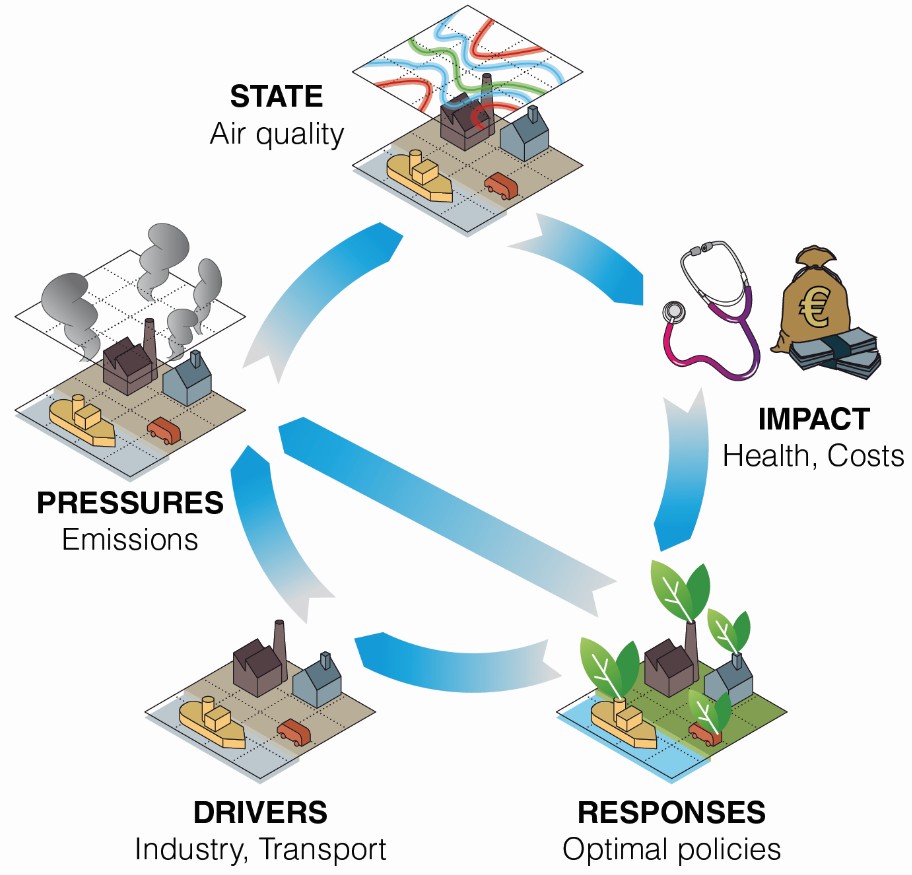
In the second phase, the developed guidelines were tested on two case studies: the Porto region (PT) and the Brussels area (BE). The methodological reference adopted was the framework suggested by the European Environment Agency (EEA), namely the DPSIR (Driver, Pressure, State, Impact, Response) scheme.
The guidelines developed define a modelling framework for Integrated Assessment, aimed at ensuring interoperability among existing models and tools and supporting evidence-based decision-making. These results were shared with stakeholders and policymakers to promote knowledge transfer and contribute to the revision of European air quality policies.
THE ROLE OF TERRARIA
TerrAria was responsible for developing the online database that enabled the survey of air quality and health assessment methodologies used across Member States and allows results to be visualised in a concise manner through graphs and reports. It supported partners responsible for the case studies in applying the selected methodology in accordance with the guidelines. TerrAria also prepared the project Layman’s Report and was a member of the Steering Committee.