To improve air quality at the urban scale
The AIR-HERITAGE project of the Municipality of Portici was funded under the third European call “Urban Innovative Actions” (UIA), an instrument of the European Union managed under indirect management by the European Commission (EC) and the Directorate-General for Regional and Urban Policy. Urban Innovative Actions calls aim to identify and test new solutions addressing issues related to sustainable urban development that are of European relevance.
The Municipality of Portici (NA), with one of the highest population densities in Italy, 73% of its surface urbanised, over 4’300 houses per km², and a strong predominance of residential functions over productive activities, is particularly exposed to air pollution and aims to address the challenge of adopting an integrated approach to improve urban air quality and protect the valuable natural and architectural components of its territory.
| Project: UIA03-322, Urban Innovative Actions Budget: 4’093’095 Euros (Managed Activities: 499’809 Euros) Duration: 2018 – 2021 Number and Partners involved: 6 project partners, all italians: Municipality of Portici – project leader (Main Urban Authority), National Agency for New Technologies, Energy and Sustainable Economic Development (ENEA), University of Naples Federico II – Department of Agricultural Sciences (Higher Education and Research Institute), Legambiente Campania Onlus (NGO), ARPAC – Campania Regional Agency for Environmental Protection (regional body) and TerrAria Srl (SME) Role: Partner Project website: uiaairheritage-portici.it |
 |
AIR-HERITAGE aims to achieve a 20% reduction in fine (PM10) and ultra-fine particles (PM2.5), as well as nitrogen dioxide (NO2), carbon monoxide (CO), and ozone (O3), together with an increase of 1’000 e-bike sharing users, the implementation of the pedibus initiative in 75% of primary schools, and a 20% increase in the number of children walking to school.
Although the main sources of air pollution are well known, with vehicular traffic representing the predominant contribution, especially in urban contexts, addressing the issue effectively requires the involvement of citizens.
From this perspective, improving knowledge of the phenomenon becomes a priority, both qualitatively and quantitatively, at appropriate levels of spatial and temporal detail. At the same time, it is essential to equip local authorities with tools capable of supporting decision-making. Finally, information sharing and active community participation play a central role.
AIR-HERITAGE involves the development of an innovative, pervasive, and versatile way of monitoring air quality, integrated with standard institutional monitoring, through citizen engagement.
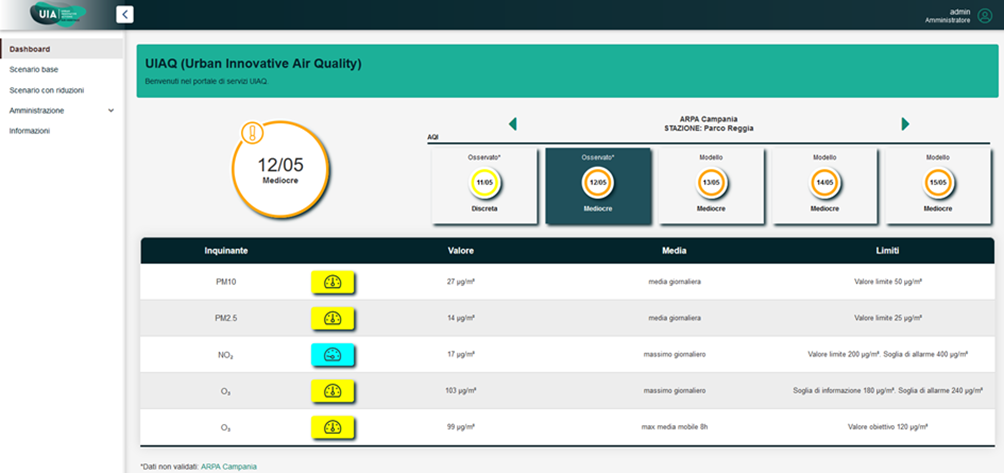
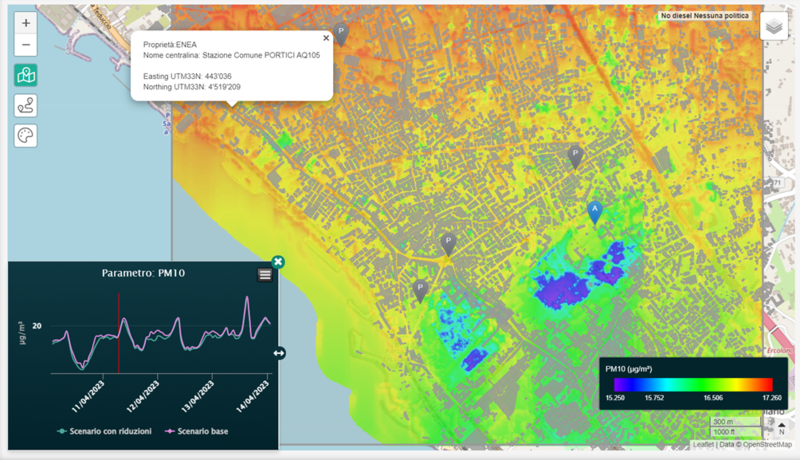
Through the modelling of collected data in relation to the local context and the development of a Decision Support System (DSS) that can be used by both public administrators and citizens, stakeholders will be able to adopt the most appropriate choices and behaviours to improve urban air quality.
Citizens themselves will be able to directly participate in monitoring by using portable sensors. Local communities, in a complementary and synergistic way, will be encouraged to adopt virtuous behaviours.
AIR-HERITAGE aims to bring about a shift in how urban air quality issues in the city of Portici are assessed and addressed, reducing the distance and barriers between stakeholders. In particular, the success of AIR-HERITAGE will have an impact on citizens’ mobility choices and political commitment toward improving air quality, as well as on urban policy decision-making processes.
THE ROLE OF TERRARIA
TerrAria was responsible for developing a Decision Support System for policymakers and an App to ensure effective citizen engagement. The DSS is a web-based application capable of integrating the results of other technical Work Packages – making air quality monitoring data available through the use of atmospheric pollutant dispersion models and different policy scenarios. To ensure the innovative nature of the solution, TerrAria also integrated Copernicus products (such as background concentrations in real-time forecasts) into the DSS. TerrAria was also a member of the Steering Committee.