Improve Resilience of Industry Sector
In response to the effects induced by climate change, the IRIS project (Improve Resilience of Industry Sector) aims to enhance the resilience of the industrial sector through methods and solutions that can be transferred across all European Union countries, promoting climate adaptation actions in synergy with environmental policies.
In this context, the IRIS project, supported by the European Union under the LIFE programme, is part of a broader European framework aimed at strengthening companies’ capacity to anticipate, manage, and mitigate climate risks, while contributing to the sustainability and competitiveness of the production system.
| Project Type: EUROPEAN LIFE14 CCA/IT/000663 Budget: 1’658’680 Euros Durata: 2015 – 2019 Number and Partners involved: 7 project partners, all italians: ERVET – project-leader, La Scuola Superiore di Studi Universitari e di Perfezionamento Sant’Anna (public university institute with special status), The Consorzio Attività Produttive (CAP) of Modena (Public Entity), S.I.PRO. (Territory Development Agency of the Province of Ferrara), Carlsberg Italia, ERGO srl, TerrAria srl Role: Partner |
 |
IRIS aims to support companies, especially Small and Medium Enterprises (SMEs), which in recent years have increasingly faced extreme climate events that threaten production facilities and infrastructure functionality.
These events include, for example, heatwaves, extreme precipitation, floods, and prolonged drought periods, which directly affect operational continuity and supply chains.
In particular, the pilot activities involved companies belonging to the same industrial area (two industrial clusters in Emilia-Romagna were selected) and companies belonging to the same production supply chain, namely Carlsberg Italia.
For each cluster, an analysis of industrial risk related to climate change was carried out; based on this analysis, a climate adaptation Action Plan for industrial sector resilience was developed; financial and insurance mechanisms based on incentive criteria for resilient companies or clusters were also investigated.
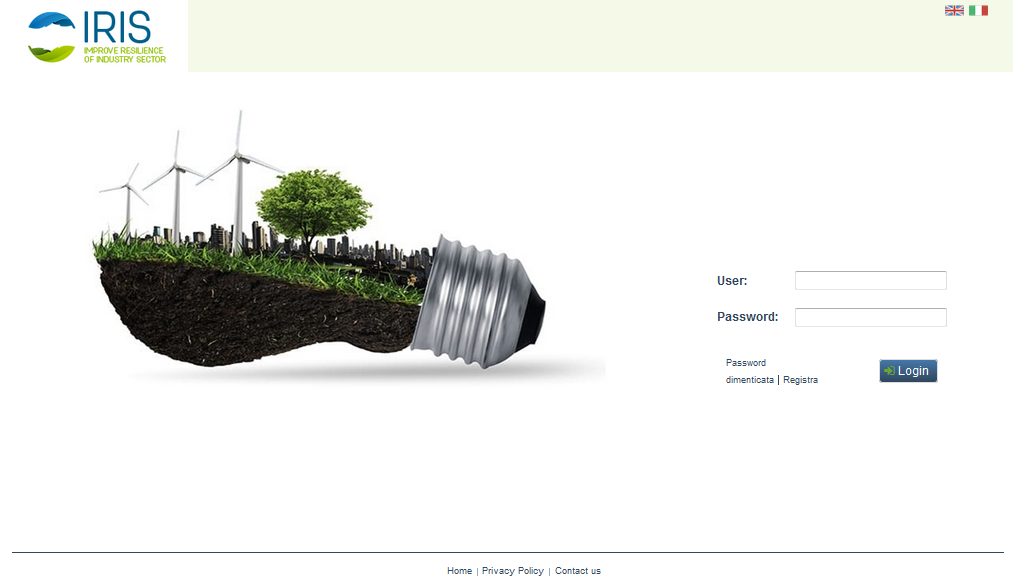
To address the lack of a tool enabling rapid assessment of the industrial sector, the CAST tool (Climate Adaptation Support Tool) was developed within the IRIS project. This screening tool supports companies in assessing their vulnerability to climate change-related risks and enables an initial identification of adaptation measures, as well as the evaluation of their effectiveness.
CAST is based on institutional meteorological databases at national and global levels, such as ISPRA (Istituto per la Protezione Ambientale e la Ricerca) and IPCC (Intergovernmental Panel on Climate Change). The climate information captures changes in the intensity (or frequency) of climate hazards in the future due to climate change, based on scientific projections that consider both historical weather events and future scenarios.
The tool generates easily interpretable assessments for various physical risks and enables users to evaluate which business segments are more or less exposed. It also allows comparison of risk analyses before and after interventions and enables users to download a report summarising the entire risk assessment performed.
The main innovative features of the CAST tool lie in its ability to integrate international standards, as well as its accessibility and operational scalability. In particular, the system is aligned with the Carbon Disclosure Project (CDP) framework, ensuring consistency between climate events and their related impacts, while also providing magnitude values and recognised best practices. The tool is designed to be transferable, thanks to the use of global meteorological databases, allowing its application across different geographical contexts.
It is delivered as a user-friendly web application, accessible via registration and compatible with major browsers. Finally, it adopts a multilingual approach (Italian and English) and a guided interface that supports users throughout the risk analysis process, making it suitable even for non-expert users.
THE ROLE OF TERRARIA
TerrAria was responsible for the development of the CAST tool, an Information System designed for companies wishing to assess their vulnerability to climate change and identify effective climate adaptation measures. TerrAria was also a member of the Steering Committee.