 Air Quality Modelling
UTAQ model
Urban-scale modelling is a key tool for analysing air quality in cities and for estimating population exposure to pollutants, supporting urban air quality plans and health assessments. The increasing attention of the European Union to the management of acute pollution episodes, established by the new European Air Quality Directive (Directive 2024/2881), has further highlighted the need for reliable forecasting systems capable of providing timely information to support decision-making.
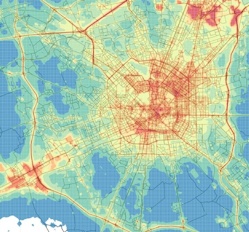
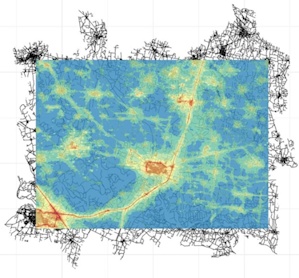
High-resolution models make it possible to represent the spatial and temporal variability of atmospheric pollutant concentrations at urban scale, taking into account emission levels and meteorological conditions, as well as observations recorded by the air quality monitoring network.
Thanks to high-resolution models it is possible to estimate the exposure of the resident population to pollutants, assess potential health effects and analyse the effectiveness of mitigation policies, such as traffic modulation or the introduction of sustainable mobility measures at urban scale. These tools play a central role not only in urban planning processes but also in supporting epidemiological studies, which require local-scale information on air pollution.
In this context UTAQ (Urban Tool for Air Quality) fits in, the high-resolution urban-scale air quality model developed by TerrAria within the project of the same name, funded by ECMWF, with the aim of providing a tool for high-resolution urban-scale air quality forecasting. Thanks to its modular structure and its ability to integrate emission and meteorological data, UTAQ makes it possible to obtain high-resolution concentration maps (25–30 m) and has been used in multiple planning and decision-support contexts, including the Urban Sustainable Mobility Plan of the Metropolitan City of Turin, the Urban Sustainable Logistics Plan of the Metropolitan City of Florence, the Air and Climate Plan of the Municipality of Milan and several epidemiological studies for health protection agency (ATS).
In all application cases, urban modelling has demonstrated its value as a high-resolution integrated analysis tool for assessing the effectiveness of different mitigation strategies on pollutant concentration trends, providing a quantitative basis useful both for defining targeted interventions and for evaluating their impact on air quality in an increasingly effective and sustainable way.