 Air Quality Modelling
CFD models
Micro-scale modelling makes it possible to analyse in detail the behaviour of fluids in complex conditions, where the presence of obstacles, irregular geometries or emission sources requires a very fine representation of air motions. At this scale, atmospheric dynamics are studied by reconstructing turbulent flows through CFD (Computational Fluid Dynamics) methods, which make it possible to simulate phenomena that are difficult to represent with local-scale models. CFD simulations are particularly useful when it is necessary to understand the interaction between wind, buildings, infrastructure and point sources, or to assess the behaviour of jets, plumes and dispersion under highly variable conditions. This approach allows a realistic description of turbulent flows generated by orography, artificial structures and emission processes, providing a solid basis for analysing pollutant concentrations in critical areas.
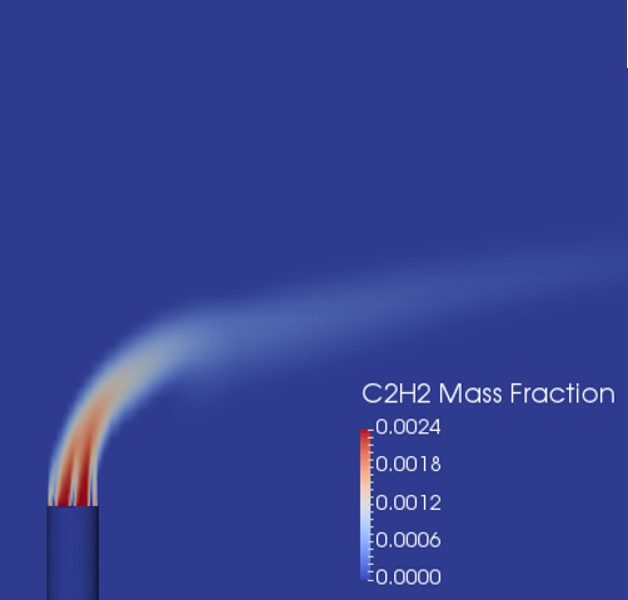
TerrAria applies micro-scale modelling using open-source CFD codes such as OpenFOAM, widely used in the scientific and industrial fields for its flexibility and its ability to represent turbulent flows. OpenFOAM makes it possible to simulate combustion, chemical transport, vortex formation and velocity distributions, providing a detailed picture of the behaviour of the physical system being modelled.
Thanks to these simulations it is possible to analyse pollutant concentrations near sources, assess smoke dispersion, study temperature and jet structure and understand the effects of turbulence generated by plants or infrastructure. Micro-scale CFD modelling also makes it possible to compare alternative scenarios, verify the effect of plant modifications, optimise construction configurations and support design in industrial and environmental contexts.