 Air Quality Modelling
RIAT+ and VERA models
Decision support models and Digital Twins meet the need to simulate the effectiveness of possible mitigation actions for the management and improvement of air quality. Through integrated emission assessment modelling, concentration calculation and the possibility of generating alternative scenarios, these tools enable decision-makers to guide environmental policies on the basis of quantitative, transparent and comparable analyses.
Decision-support models play a central role in this process: they make it possible to quantitatively assess the effects of environmental policies, compare alternative scenarios, estimate costs and benefits and identify the most effective measures for reducing concentrations. Thanks to an integrated approach, these tools combine emission inventories, atmospheric models, socio-economic information and optimisation techniques, making more informed, transparent and results-oriented planning possible.
At the same time, the evolution and development of Digital Twins, true “digital replicas” of the territory capable of reproducing real dynamics in a virtual environment. The integration of observed data, physical models and advanced algorithms, including neural networks and machine learning approaches, makes it possible to obtain high-resolution representations of the territory and emission behaviour, paving the way for new forms of predictive and proactive governance.
Together, decision support models and Digital Twins provide a solid basis for addressing the challenges of environmental planning, supporting the definition of more effective policies thanks to the simulation of the impact of different scenarios. Both tools foster cooperation between administrations and concretely contribute to improving well-being and urban quality of life.
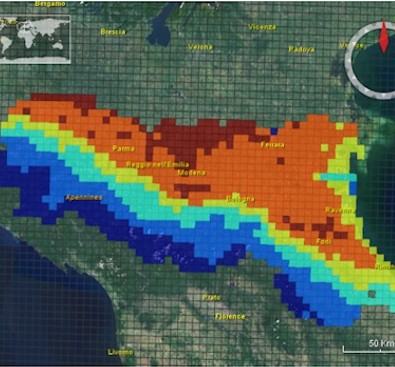
In this context several solutions developed by TerrAria and applied in international and national regional contexts are included. These include RIAT+, an integrated assessment modelling tool that supports the identification of the most efficient emission reduction measures, and VERA, the digital twin of Emilia-Romagna that integrates data, models and advanced algorithms to dynamically and predictively analyse the impact of policies on air quality.