Assessment of atmospheric and climate impacts of the Section D Variant of the Pedemontana Project
The Section D Variant of the Dalmine–Como–Varese–Gaggiolo Border highway link is a road infrastructure project of the Lombard Pedemontana Highway, crossing nine municipalities in the province of Monza and Brianza, within one of the most densely populated and air-quality-critical areas of the Po Valley. In this context, TerrAria supported the assessment of atmospheric and climate impacts, including the related Environmental Monitoring Plan, as well as the assessment of human health impacts of the project. The following section focuses on the air and climate components, both during the construction and operational phases.
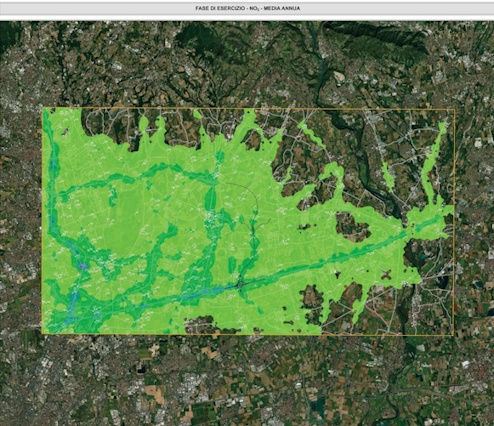
The new Section D Variant project is subject to a renewed Environmental Impact Assessment due to route changes compared to the previously approved project (Approved Section D Variant). The assessment of atmospheric impacts was therefore conducted by analysing the construction scenario and three operational phase scenarios, through an advanced modelling approach aimed at estimating variations in pollutant concentrations and providing guidance for infrastructure planning.
Methodology
The assessment of atmospheric impacts generated by the project in terms of air quality was carried out using the CALPUFF dispersion model. Meteorological data from the ARPA station most representative of and closest to the site were processed using the MICROMETEO pre-processor, developed by ARPA Veneto and TerrAria, to reconstruct wind conditions, turbulence and atmospheric stability. Results were subsequently post-processed with CALPOST to obtain regulatory indicators (annual averages, percentiles, etc.).
From an emissions perspective, traffic- and construction-related emissions were considered for each scenario.
With regard to the operational phase, in order to assess the impact of the project on the air matrix, three mobility scenarios were analysed:
- 2035 Reference Scenario, corresponding to the 2035 infrastructure configuration including the construction and operation of Sections B2 and C of the Lombard Pedemontana Highway;
- “Approved Section D Variant” Scenario, corresponding to the previous 2035 reference scenario with the addition of the Approved Section D Variant contribution;
- “Approved Section D” Scenario, corresponding to the 2035 reference scenario with the addition of the Approved Section D contribution.
Vehicular emissions were calculated based on emission factors obtained using COPERT 5.5, the European reference model, and traffic flows for light and heavy-duty vehicles, modulated according to peak hour and daily profiles. The pollutants analysed were NO₂, PM10, PM2.5, CO and benzene, typical of road traffic emissions. The Section D Variant entails a slight increase in vehicle kilometres travelled (+2.7%), but, due to congestion reduction, improves overall traffic distribution. Consequently, maximum domain concentrations under the Approved Section D Variant scenario decrease for all pollutants considered compared to the reference scenario (-2% / -3.5%), contributing to the mitigation of congestion along the A51 and the A4 highway west of the A4-TEEM interchange. The Variant also performs better than the Approved Section D scenario in terms of domain maxima for all pollutants considered (up to -2.9%) and also with respect to domain averages, with the exception of particulate matter.
Regarding the construction phase, the analysis focused on particulate matter and nitrogen oxides, considering the following activities:
- emissions from construction machinery and equipment, including heavy-duty vehicles for the transport of construction materials, quarry materials and generated waste;
- generation and resuspension of dust from handling, transport, loading and storage of dusty materials;
- movement of construction vehicles on unpaved roads.
In the construction phase simulation, it was conservatively assumed that the entire year of works corresponded to the most emissive month. Even under these conditions, PM10 and PM2.5 ground-level impacts remain limited, while NO₂ shows more evident increases in construction site areas.
For both the construction and operational phases, impact mitigation measures were assessed as an integral part of infrastructure planning.
With respect to the climate component, the pressure categories generated during the operational phase are related to greenhouse gas emissions from circulating traffic. From a climate perspective, the assessment of territorial impacts associated with the project indicates limited and negligible effects in terms of CO₂ equivalent.
THE ROLE OF TERRARIA
TerrAria was responsible for drafting the specialist report, including the development of emissions scenarios and the full modelling assessment chain up to the estimation of ground-level concentrations for the scenarios considered. In particular, TerrAria supported the construction of construction and operational emissions scenarios, the processing of emission factors using the COPERT model, and the identification of sensitive receptors. In addition, the company configured and applied the MICROMETEO–CALPUFF–CALPOST system to represent local conditions and pollutant transport and dispersion processes within the simulation domain, and compared the results with regulatory limits (annual averages, percentiles and domain maxima). This integrated approach enabled the production of a comprehensive assessment of the atmospheric impacts of the Approved Section D Variant on air quality and climate, providing a technical framework to support the authorisation process and infrastructure planning decisions.