Environmental Impact Assessment for human health, air and climate, noise and vibration components
The project to upgrade the interconnection between the Milan North freeway (A52) and the Turin–Venice highway (A4) represents a strategic infrastructure intervention for mobility within the Milan metropolitan area and for the Lombardy road network system, also in relation to the works connected to the 2026 Winter Olympics. As part of the Environmental Impact Assessment (EIA), TerrAria carried out an integrated evaluation of the project’s effects in relation to air quality, climate, human health, acoustics and vibration, during both the construction and operational phases.
The objective of the EIA is to assess the impact of the interconnection upgrade on air quality, climate, human health, acoustics and vibration within the Environmental Impact Assessment procedure.
Upon completion of the EIA, a comprehensive Environmental Monitoring Plan was defined for air, noise and vibration, aimed at verifying over time the consistency between forecasts and actual conditions, ensuring transparency, control and protection of the surrounding area.
The Project includes the introduction of the following structural elements:
- construction of a new section predominantly in tunnel alongside the existing tunnel and consequent modification of the interchange between the A4 and the A52 to allow access to it;
- widening of the A52 North Freeway carriageway with reconfiguration to 3 traffic lanes plus an emergency lane;
- upgrading of an interchange and modification of the alignment of the entrance ramp to the Freeway from the Borgazzi roundabout;
- construction of a new exit ramp from the Freeway towards the current Via Edison;
- introduction of a roundabout near Via Edison, connection of the newly constructed ramp and integration with the existing local road network;
- modification of the interchange between the A52 towards Rho and the SS36 towards Lecco.
The project, based on an integrated approach and advanced modelling methodologies, aims to combine infrastructure development, environmental sustainability and health protection.
Air Quality and Climate
For the air component, the approach adopted for the operational phase consists of assessing the expected pressures in terms of changes in traffic flows, the related emissions and, finally, the concentrations of air pollutants between the baseline scenario and the project scenario. Similarly, during the construction phase, the impact in terms of emissions is assessed and concentrations associated with the various planned activities (emissions from construction machinery and equipment, emissions generated by heavy-duty vehicles transporting materials and waste, dust generation and resuspension, and the movement of construction vehicles on unpaved roads).
To minimise construction impacts, best practices will be implemented to reduce and contain atmospheric emissions, including, for example, washing vehicles before leaving the site, installing particulate control devices on machinery operating within the construction area, covering materials with tarpaulins, wetting loose material stockpiles, and limiting vehicle speeds within the quarry/construction site area, particularly along unpaved routes.
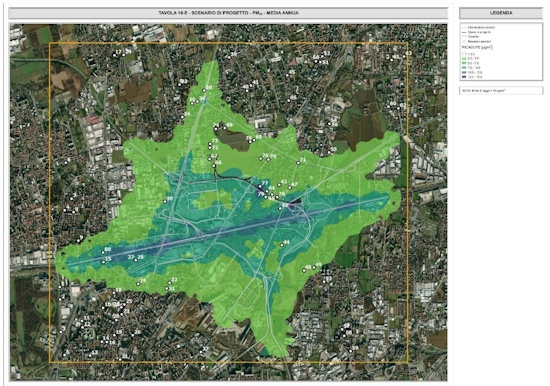
Specific mitigation measures have been defined to be integrated into the project to reduce pollutant concentrations during the operational phase. These include the use of titanium dioxide-based paints in the outermost section of the tunnel of the new infrastructure branch connecting to the A52, as well as the planting of trees, shrubs and flowering meadows along the project corridor. Traffic emissions were estimated using the European COPERT model, while pollutant dispersion was simulated using the non-steady-state Lagrangian model CALPUFF, based on local meteorological data processed through the MICROMETEO pre-processor. Model outputs were subsequently processed using the CALPOST post-processor, which enables extraction of regulatory statistics for the various pollutants (percentiles, annual averages, etc.).
The impact of the construction phase, despite the highly precautionary approach adopted—considering maximum monthly emissions extended over an entire year—proved to be limited and short-term, thanks to the implementation of best practices and specific mitigation measures.
The results show that, during the operational phase, the project leads to a slight reduction in vehicle kilometres travelled during peak hour and a consequent overall decrease in emissions for all pollutants considered (NO₂, PM10, PM2.5, CO and benzene). This benefit translates into a reduction of both maximum and average domain concentrations, with positive effects extending beyond the limited areas of slight increase, which are located in sparsely urbanised contexts.
From a climate perspective, the assessment of expected pressures in terms of GHG (Green House Gases) emissions associated with the project was carried out through an in-depth analysis of the current meteorological-climatic and emissions context, followed by quantification of the project’s contribution in terms of CO2 equivalent.
The project results in a reduction of greenhouse gas emissions of approximately 0.11 kt of CO₂ equivalent compared to the baseline scenario, further mitigated by the planned creation of new green areas.
Human Health
The assessment of impacts on human health considered the air and noise matrices within a territorial context characterised by pre-existing hydraulic and geotechnical vulnerabilities. Risk analyses indicate that there are no significant increases in carcinogenic or non-carcinogenic risk from inhalation: the estimated variations remain well below thresholds of health relevance.
Similarly, evaluations based on the World Health Organization guidelines show an overall neutral or slightly improving balance of the project with regard to the risk of ischaemic heart disease, high annoyance and sleep disturbance related to traffic noise.
Noise, Vibration and Environmental Monitoring
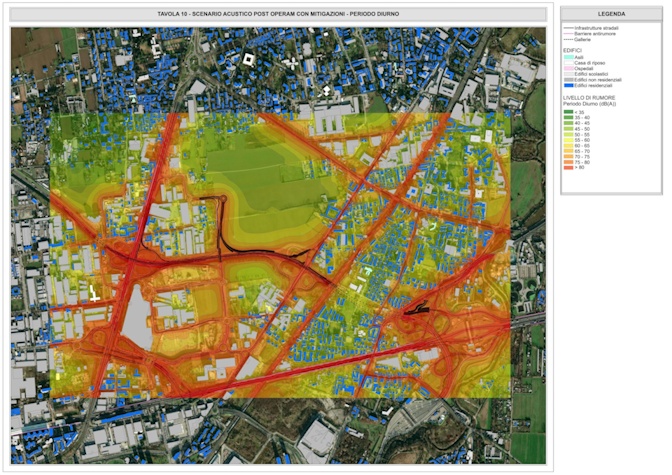
Noise and vibration impacts were analysed for the pre-operam, construction and post-operam scenarios, supported by predictive modelling and measurement campaigns. The processing of the different acoustic scenarios was carried out using dedicated predictive software SoundPLAN 9.0, with input data provided by the client and subsequently calibrated through dedicated on-site noise monitoring campaigns conducted within the study area.
Any critical issues identified during the construction phase are temporary and manageable through specific mitigation measures. During the operational phase, the estimated levels comply with regulatory limits at all sensitive receptors.
THE ROLE OF TERRARIA
TerrAria S.r.l. supported the A52–A4 interconnection upgrade project by carrying out environmental assessments related to air quality, climate, noise, vibration and human health. Through the use of advanced predictive models and the integrated analysis of traffic and meteorological data, TerrAria contributed to quantifying the project’s emission impacts during both the construction and operational phases and to assessing its environmental compatibility. The company also collaborated in defining mitigation measures and the Environmental Monitoring Plan, aimed at safeguarding public health and the surrounding area.