Assessment of CO₂ Equivalent Across the Entire Product Life Cycle
LBG Sicilia Ingredients, a company specialized in the production of high-quality functional ingredients and systems for the food industry and operating across two production sites in the Ragusa area, operates in a context where the quantification of greenhouse gas emissions represents a strategic tool for ecological transition and for strengthening competitiveness. For a manufacturing company such as LBG Sicilia, determining the Product Carbon Footprint (CFP) makes it possible to quantify greenhouse gas (GHG) emissions expressed as CO₂ equivalent across the entire product life cycle—from raw material procurement (carob), to production, transport, and final use—identifying the phases with the greatest impact and defining strategies for process optimization, improvements in energy efficiency and the company’s environmental efficiency, and emission reductions.
Within the European and Italian regulatory framework, the measurement of greenhouse gas (GHG) emissions is encouraged by Directive 2014/95/EU (implemented through Legislative Decree 254/2016), which concerns corporate reporting of environmental impacts with the aim of promoting ecological transition. The UNI EN ISO 14067:2018 standard governs the Product Carbon Footprint (CFP), while UNI EN ISO 14064-1:2019 regulates the Organizational Carbon Footprint (CFO), integrating the GHG Protocol for standardized calculations that can be verified by third parties.
The product carbon footprint is divided into several stages, including defining the objective of the analysis and the system boundaries, collecting input and output data relating to the product under consideration, calculating emissions in terms of CO₂ equivalent, and drafting the final report.
GHG, on the other hand, represents the total set of climate-altering gases emitted by the company, distinguishing between Scope 1 (direct emissions, e.g., gas boilers), Scope 2 (indirect emissions from purchased energy), and Scope 3 (value chain emissions, e.g., supplier transport or product use). For a manufacturing company, calculating GHG emissions supports decarbonization strategies such as investments in solar energy or electric logistics, reducing operating costs and regulatory risks while contributing to the company’s environmental efficiency. Together, CFP and GHG promote integrated sustainability, improving resilience and attractiveness for ESG investors while supporting process optimization pathways.
The GHG assessment develops through several stages: defining the purpose of the analysis, identifying organizational and analytical boundaries, identifying the company’s relevant emission sources, collecting consumption data and emission factors, calculating emissions, and drafting the final report.
LBG Sicilia was founded in Ragusa in 2001 and began the production and commercialization of carob seed flour. Today it is considered one of the most innovative carob seed flour production facilities in Italy and worldwide. In 2013 the company completed a significant investment to improve the production capacity of carob seed flour and created a new technologically advanced plant along with a research and development center for the production of functional systems.
LBG Sicilia consists of two sites: the main facility located in the Zona Industriale III Fase in Ragusa, and a second site with lower consumption located in Contrada Genisi. At the Contrada Genisi site, the carob pods are split in order to obtain the carob seeds that subsequently enter the Ragusa plant.
THE ROLE OF TERRARIA
TerrAria, drawing on many years of experience in energy efficiency and energy management, prepares GHG and Product Carbon Footprint reports for manufacturing companies, starting from preliminary analyses, defining the scope of the assessment, and acquiring and processing data, with the aim of supporting process optimization pathways.
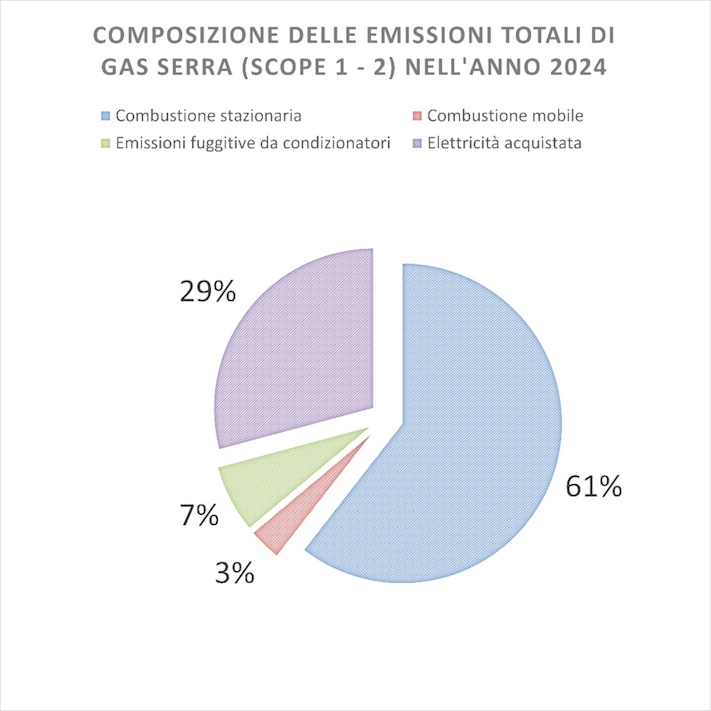
Specifically, in the case of LBG Sicilia, since 2022 TerrAria has carried out several GHG analyses, product carbon footprint assessments, and organizational carbon footprint studies. The GHG analysis made it possible to evaluate the trend over the last five years in terms of the quantity of CO₂ equivalent emissions for each type of activity within the scopes defined by the GHG Protocol (stationary combustion, mobile combustion, fugitive emissions from air conditioning systems, and purchased electricity). It also made it possible to assess the company’s environmental efficiency over the years by comparing GHG emissions with the quantity of product output.
With regard to the CFP, it was possible to obtain the total quantity of greenhouse gases expressed in tonnes of CO₂ equivalent attributable to each category of the CFP inventory (purchase and transport of raw materials, packaging and packing materials, outgoing product transport, employee transport and business travel, transport and disposal of waste, and water consumption).