Update of the Update of the Air Quality Improvement Plan and Strategic Environmental Assessments (SEA) of Lazio Region
The Air Quality Improvement Plan is the planning instrument through which the Lazio Region implements Directive 96/62/EC and its subsequent amendments concerning the assessment and management of air quality, defining the strategic framework for implementing air quality improvement policies across the regional territory.
In accordance with sector-specific legislation, the Air Quality Improvement Plan has two general objectives:
- Improving air quality in areas where regulatory limits have been exceeded or where there is a high risk of exceedance, through structured measures for the assessment and management of air quality;
- Maintaining air quality in the remaining areas of the territory.
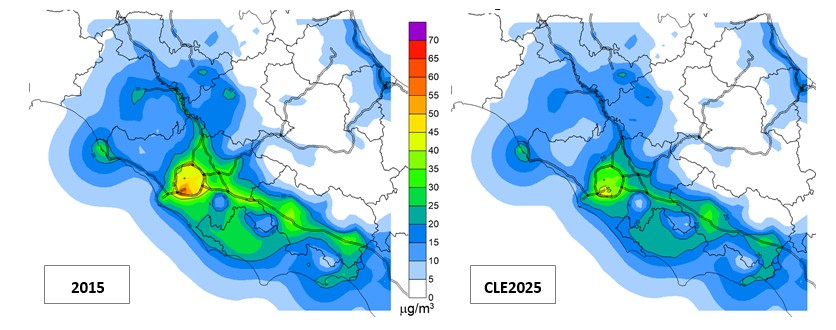
The update of the Air Quality Improvement Plan approved in 2009 identifies a Plan emission scenario for 2025 capable of ensuring compliance with current legal air quality limits. In addition to the emission scenario, it also identifies a set of measures that contribute to achieving that scenario, strengthening the regional system for the assessment and management of air quality.
The measures implemented by the Lazio Region in recent years, across the various sectors contributing to atmospheric emissions, have made it possible to achieve a significant improvement in air quality. However, some critical issues remain related to the exceedance of air quality standards for atmospheric particulate matter (PM10 and PM2.5) and nitrogen dioxide (NO2). It is therefore important to proceed with further steps toward improving these critical situations.
According to Regional Government Resolution No. 834 of 30/12/2016, the specific objectives of the update of the Air Quality Improvement Plan are the following:
- Achieving ambient air quality levels aimed at avoiding, preventing or reducing harmful effects on human health and the environment as a whole in areas where air quality standards were exceeded in 2015
- Maintaining air quality levels in areas where air quality standards were met in 2015
- Improving knowledge in support of the formulation, implementation, evaluation and monitoring of air quality improvement policies.
The intervention sectors identified by the Air Quality Improvement Plan, for which actions have been defined, are:
- Transport sector, for which 4 measures and 16 actions have been identified
- Civil combustion sector, namely the sector related to heating in the residential and tertiary sectors, both using biomass and other fuels, for which 2 measures and 13 actions have been identified
- Production processes sector, with 1 measure and 4 actions
- Agriculture and livestock sector, with 1 measure and 6 actions
- Diffuse emissions sector, with 1 measure and 3 actions.
In particular, in order to reduce emissions in the Lazio Region, the Plan identifies the following sectors.
- Non-industrial combustion: aimed at reducing particulate emissions (PM10) mainly resulting from the combustion of woody biomass, but also from other fuels, through both renewal and maintenance interventions on the plant stock as well as energy efficiency measures;
- Road transport: aimed primarily at reducing nitrogen oxides (NOx) emissions resulting from the combustion processes of engines in diesel-powered vehicles (cars, light vehicles and buses) and gasoline-powered vehicles (cars);
- Production processes: aimed primarily at reducing nitrogen oxides (NOx) emissions generated by combustion in industrial production processes;
- Agriculture and other diffuse emissions: aimed at reducing ammonia (NH3) emissions resulting from livestock manure management and, in the case of open burning, particulate emissions.
THE ROLE OF TERRARIA
TerrAria provided assistance and support services for the drafting of the update of the Air Quality Improvement Plan, as well as for the Strategic Environmental Assessment (SEA) process, contributing to the definition of tools for air quality assessment and management.
With regard to the Plan, the activities carried out included:
- Identification and assessment of emission sources, including the identification of the five intervention sectors and those requiring the introduction of specific and targeted measures.
- Technical and economic analysis of the measures envisaged by the Air Quality Improvement Plan, consisting of integrating environmental information with the proposed measures in order to define possible scenarios including a cost–benefit analysis. The scenarios are defined through the identification of specific sets of measures included in the Plan.
- Preparation of the Plan documentation, including the drafting of the Report, the Technical Implementation Provisions and the cartographic documents.