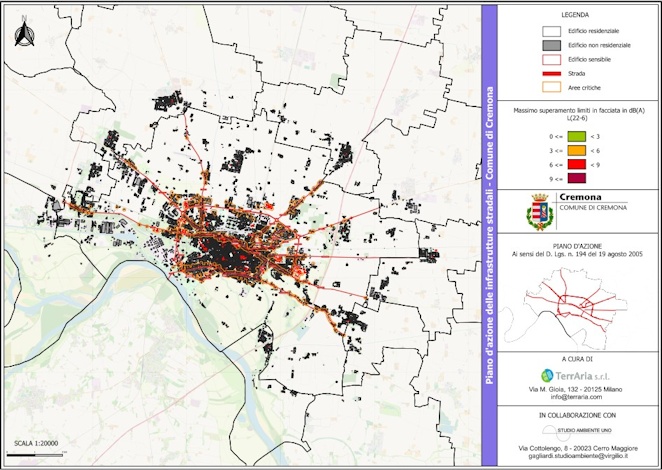
Action Plan for the mitigation of noise impact in the Municipality of Cremona
The Action Plan of the Municipality of Cremona represents the programmatic and operational phase following the Noise Mapping of municipal road infrastructures, prepared pursuant to Legislative Decree 194/2005. Unlike the Noise Mapping, which is aimed at describing the acoustic climate, the Action Plan focuses on mitigating noise impact and managing traffic noise through the assessment of improvements achieved by noise mitigation measures. Interventions to reduce traffic noise along road infrastructures include resurfacing works, installation of noise barriers and construction of pedestrian crossings. These measures were defined in collaboration with the municipal urban planning offices and assessed through dedicated simulation analyses.
The document is based on an in-depth analysis conducted during the Noise Mapping phase of the population’s noise exposure, carried out through a modelling approach integrating traffic data with the geometric and functional characteristics of municipal road axes affected by traffic volumes exceeding 3 million vehicles/year, for the purpose of noise management.
The analysis shows that the most critical exposure conditions for the population are concentrated in areas immediately adjacent to road infrastructures, within a maximum distance of approximately 30 metres from the road edge, making it necessary for mitigating noise impact through targeted and localised interventions.
The assessment of the acoustic climate and of the effects of the proposed mitigation measures was carried out through modelling simulations using SoundPLAN ver. 9.0, implementing the European CNOSSOS-EU method, updated in accordance with Commission Delegated Directive (EU) 2021/1266. The CNOSSOS-EU method, developed by the European Commission with contributions from EEA (European Environment Agency), WHO (World Health Organization)/Europe and EASA (European Union Aviation Safety Agency), ensures consistency with EU standards for the management of urban environmental noise.
Exposure of receptors was estimated using the following descriptors:
- Lden and Lnight, for harmonised analysis at European level;
- Leqday and Leqnight, used for direct comparison with national regulatory limits.
This dual approach made it possible to estimate, both before and after the interventions, the number of people exposed to noise levels exceeding legal limits and to quantify the achievable improvements in terms of mitigation of noise impact on the resident population, with particular attention to sensitive receptors (schools and healthcare facilities).
The Action Plan also incorporates an assessment of the harmful effects of environmental noise on health, with reference to the WHO Guidelines (Environmental Noise Guidelines for the European Region, 2018) and updates to Directive 2002/49/EC.
In particular, the following health impact indicators were considered:
- ischaemic heart disease;
- high annoyance;
- severe sleep disturbance.
The Action Plan was adopted by the Municipality of Cremona and subsequently published on the institutional website and on the online Official Notice Board. In accordance with Article 8 of Legislative Decree 194/2005, a public participation phase was launched, during which citizens were able to submit observations and written contributions within the prescribed timeframe, thereby actively contributing to noise management processes within the municipal territory.
The expected benefits were quantified in terms of:
- reduction in the number of people exposed to noise levels exceeding legal limits;
- improvement of sound levels in the most critical areas;
- support to local urban noise remediation policies.
In particular, it was estimated that following the planned interventions, the number of people affected by ischaemic heart disease would remain unchanged, while there would be a reduction of 88 individuals experiencing high annoyance and a decrease of 23 people affected by severe sleep disturbance.
The Action Plan of the Municipality of Cremona thus constitutes an essential operational tool for traffic noise management, aimed at safeguarding public health and improving quality of life in the urban context.
Following its adoption, the Action Plan was published on the Municipality’s website and made available to citizens, who were granted 45 days, as provided for by Article 8, paragraph 2 of Legislative Decree 194/05, to submit observations. In the absence of any observations received, the Plan was definitively approved.
THE ROLE OF TERRARIA
TerrAria supported the Municipality of Cremona in the preparation of the Action Plan for the mitigation of road infrastructure noise, carrying out acoustic modelling activities in collaboration with an acoustic consultancy firm, evaluating intervention scenarios and estimating the expected benefits. Its expertise in environmental acoustics and the use of advanced predictive tools enabled the provision of technical support for defining urban-scale noise management and mitigation strategies.