Artificial Intelligence for aiR quality ObservatioN in urban Environments
AIRONE is a project selected under FIERCE – 1st Open Call for the Financial Support Program, with the aim of improving high-resolution air quality estimation in urban environments.
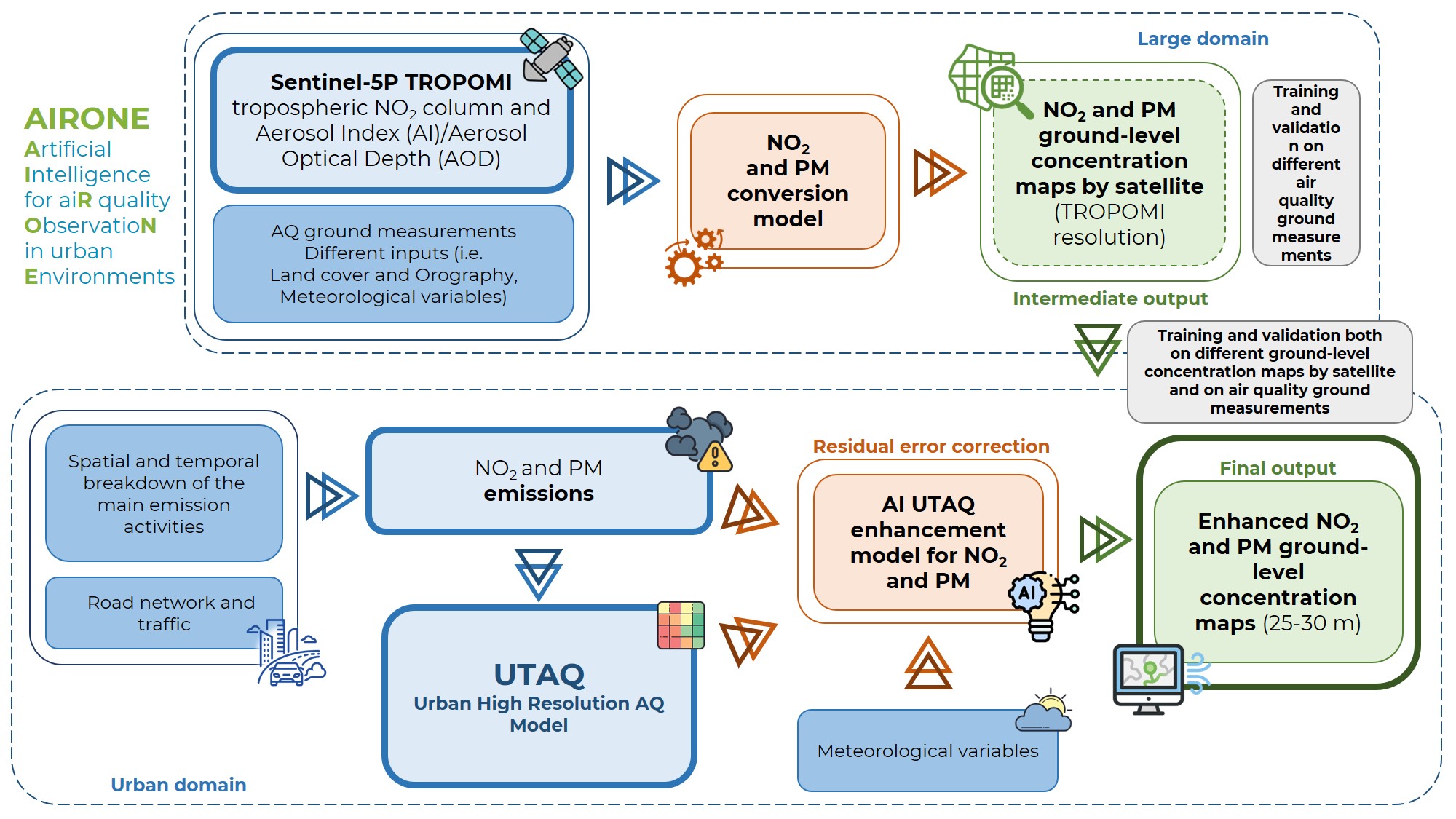
The project develops an evolution of UTAQ – Urban Tool for Air Quality, integrating Copernicus Sentinel-5P satellite data, meteorological information, emission data and artificial intelligence techniques to produce more accurate maps of NO₂ and particulate matter. The solution supports near real-time monitoring, short-term forecasting and urban environmental planning.
| Project type: Scale-up Project / MiImprovement of existing products and services Budget: 50’000 Euros Duration: 6 months Partners involved: TerrAria Srl (TA), with the support of DATINNOVA as subcontractor Ruolo: Coordinator and responsible for the development of the enhanced UTAQ system |
 |
Despite the improvements recorded in recent years, air quality in Lombardy and in the urban area of Milan remains a critical environmental and public health issue. The atmospheric conditions of the Po Valley limit pollutant dispersion and contribute to frequent exceedances of limit values, within a regulatory framework made more stringent by EU Directive 2024/2881.
Ground-based monitoring networks provide accurate measurements, but their spatial coverage remains limited. This low territorial representativeness makes it difficult to describe the local variability of pollutants, particularly nitrogen dioxide (NO₂) and particulate matter, reducing the effectiveness of planning, prevention and mitigation actions in urban contexts.
AIRONE aims to improve high-resolution estimation of urban air quality, enabling more precise identification of pollution hotspots and providing more reliable decision support for public authorities, local administrations and stakeholders involved in environmental planning.
The solution is based on the integration of the UTAQ system with Copernicus Sentinel-5P satellite data and AI-based data fusion models. Satellite observations, including tropospheric NO₂ columns and aerosol-related indicators, are processed to derive ground-level concentrations.
The core innovation of the project lies in the development of an AI-based data fusion module capable of integrating UTAQ model outputs, meteorological data, emission information, in situ measurements and satellite-derived concentrations.
This approach makes it possible to reduce residual errors, improve the spatial consistency of estimates and obtain more reliable maps of NO₂ and PM. The system will support near real-time monitoring, short-term forecasting up to 3 days and the assessment of targeted interventions, such as low-emission zones, traffic restrictions or local measurement campaigns.
The project will deliver satellite-derived gridded datasets of ground-level NO₂ and PM concentrations, high-resolution UTAQ simulations over Milan, an artificial intelligence module integrated into the operational workflow, and validation results demonstrating performance improvements compared to the current system.
AIRONE aims to reduce estimation errors compared to the current version of UTAQ and to make the workflow more automated, documented, transferable and replicable in other European urban contexts.
THE ROLE OF TERRARIA
TerrAria coordinates the project and provides the UTAQ system, modelling expertise and experience gained in the field of urban air quality.
The TerrAria team manages data preprocessing, satellite data handling, UTAQ model execution and the development of the satellite-to-surface conversion chain for NO₂ and PM. TerrAria also ensures the operational integration of UTAQ outputs and artificial intelligence models into a single, scalable and transferable workflow.
DATINNOVA supports the project as subcontractor, contributing specialist expertise in artificial intelligence, data science and the development of data fusion models.