Air quality plans of the Autonomous Provinces of Trento and Bolzano
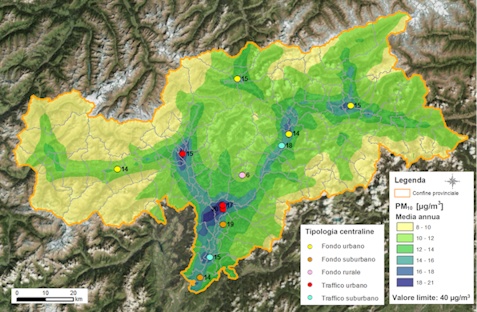
For the drafting of the air quality plans of the Autonomous Provinces of Trento and Bolzano, the respective Provincial Environmental Protection Agencies (APPA) selected TerrAria to carry out a comprehensive modelling assessment of air quality status at the regional scale through the WRF–CAMx modelling chain. The assignment, carried out in the period 2016–2017, required the application of an advanced modelling chain capable of representing the meteorological and orographic specificities of the Alpine context, where the interaction between complex topography and atmospheric conditions significantly influences pollutant dispersion.
The regional modelling assessment was performed using the WRF–CAMx modelling chain. The meteorological model WRF (Weather Research and Forecasting) provided the three-dimensional fields of atmospheric variables required to drive the chemical transport model CAMx (Comprehensive Air Quality Model with Extensions). CAMx, developed since the early 1990s and continuously updated, is included among the photochemical models recommended by the Environmental Protection Agency (EPA) for estimating secondary pollutants and allows the consistent representation of pollutant transport, chemical transformation and deposition processes from the urban to the regional scale.
The reconstruction of meteorological conditions was carried out by CISMA S.r.l., while the air quality modelling assessment of the two provinces was conducted by TerrAria.
The entire regional territory was simulated through a modelling domain of 200×200 km centered on the Trentino Alto Adige region with spatial resolutions of 2×2 km and 500×500 m, in order to capture the complexity of local phenomena and minimize uncertainties in boundary conditions. Reference meteorological conditions were reconstructed using configurations specifically designed for the Alpine context, while the emission framework was built by integrating the most up-to-date inventories available for Italian regions (INEMAR) with the corresponding European inventory (EMEP) for areas outside Italy within the modelling domain. Point source emissions were provided by the competent ARPA/APPA agencies, ensuring consistency and reliability of the input data.
CAMx outputs include hourly three-dimensional concentration fields for all considered pollutants — nitrogen oxides, particulate matter (PM10 and PM2.5), carbon monoxide, sulfur dioxide, benzene and tropospheric ozone — as well as dry and wet deposition fluxes. Model validation was carried out by comparing the results with measurements from monitoring stations located within the two provinces, according to the procedures defined by Legislative Decree 155/2010. The verification confirmed compliance with the uncertainty levels allowed by the regulation, ensuring the robustness of the simulations and their reliability within the framework of air quality planning.
The modelling assessment highlighted specific critical issues within the territory, in particular exceedances of regulatory limits for nitrogen dioxide and for some statistical indicators related to tropospheric ozone. These results constituted an essential element for guiding the improvement policies and the forecasting assessments included in the air quality plans of the two provinces.
THE ROLE OF TERRARIA
During the project, TerrAria was responsible for the complete preparation of the inputs required to run CAMx, including the construction of the emission framework, the definition of atmospheric chemistry, the setup of modelling domains, the processing of boundary conditions and the preparation of the files required to run the simulations. TerrAria also managed the configuration of the simulations, the processing of results, the verification of model performance and the technical interpretation of outputs in collaboration with the two APPA agencies.
The work required a multidisciplinary approach: advanced modelling expertise, knowledge of emission processes, the ability to analyze Alpine meteorology and particular attention to numerical validation. The experience gained in designing and managing the WRF–CAMx modelling chain made it possible to build a coherent and robust regional framework suitable for the needs of provincial planning.
The final result therefore represents a reliable technical and scientific basis for defining improvement measures and for monitoring the evolution of air quality in subsequent years.