Environmental impact assessment of biomass-fuelled boilers
The Biomaxeff project “Cost efficient biomass boiler systems with maximum annual efficiency and lowest emissions” was funded under the European Union’s Seventh Framework Programme for Research and Technological Development. Its objective is to demonstrate the effectiveness of highly efficient, ultra-low emission domestic pellet boilers through an integrated environmental and economic assessment approach.
In particular, Life Cycle Assessment (LCA) and Life Cycle Costing (LCC) analyses were carried out using specialised software (SimaPro v.8.01) and recognised databases (Ecoinvent v.3.0), applying established methodologies such as EcoIndicator 99 and ReCiPe Endpoint.
In addition, technological penetration scenarios were developed for EU27 countries to estimate potential benefits in terms of emission reductions in the residential sector. These analyses showed that the adoption of innovative technologies can significantly contribute to achieving European decarbonisation and energy efficiency targets.
The project focuses on the development of low-power, highly efficient, and ultra-low environmental impact biomass boilers for low consumption prefabricated buildings. Biomass fuels are considered climate-neutral energy sources, as they release into the atmosphere only the amount of carbon previously absorbed by plants during their growth. Furthermore, the project achieved improved emission performance, particularly in reducing fine particulate matter (PM10), nitrogen oxides (NOX), carbon monoxide (CO), and sulphur dioxide (SO₂), thereby contributing to improved air quality and reduced health risks in urban and rural areas.
| Project:BIOMAXEFF – Cost Efficient boiler system with maximum annual efficiency and lowest emissions. Valutazione di impatto ambientale di nuovi modelli di caldaie domestiche a pellet. Type of project: EUROPEAN FP7 268217 Budget: 4’238’559 Euros Duration: 2012 – 2014 Number and Partners involved: 13 project partners, Università Cattolica Del Sacro Cuore (IT), WhTech – Windhager Zentralheizung Technik GmbH (A), Windhager Zentralheizung GmbH (A), Elk Fertighaus AG (A), Bioenergy 2020+GmbH (A), BIOS Bioenergiesysteme GmbH (A), Nilan A/S, Denmark (DK), Bio Intelligence Service S.A.S (FR), German Biomass Research Centre(D), Technologie- und Förderzentrum (D), CERTH – Centre for Research & Technology Hellas (GR), Centro de Investigaciones Energéticas, Medioambientales y Tecnológicas (SP), CWP – Consulting With Purpose Ltd (UK) Role: Subcontractor Client: Università Cattolica Del Sacro Cuore |
 |
The project results showed that pellet boilers have an overall environmental impact ranging from 30% to 47% compared to oil boilers (EcoIndicator 99), and from 25% to 35% according to the ReCiPe method, while natural gas boilers exhibit impacts close to 85–90% relative to the oil-based reference. The innovative solutions developed within the project therefore represent the most effective options from both environmental and energy perspectives.
From an economic standpoint, the Life Cycle Costing analysis considered research and development, production, transport, and fuel costs, demonstrating that innovative pellet boilers ensure low lifecycle costs, making them a sustainable solution for the residential sector.
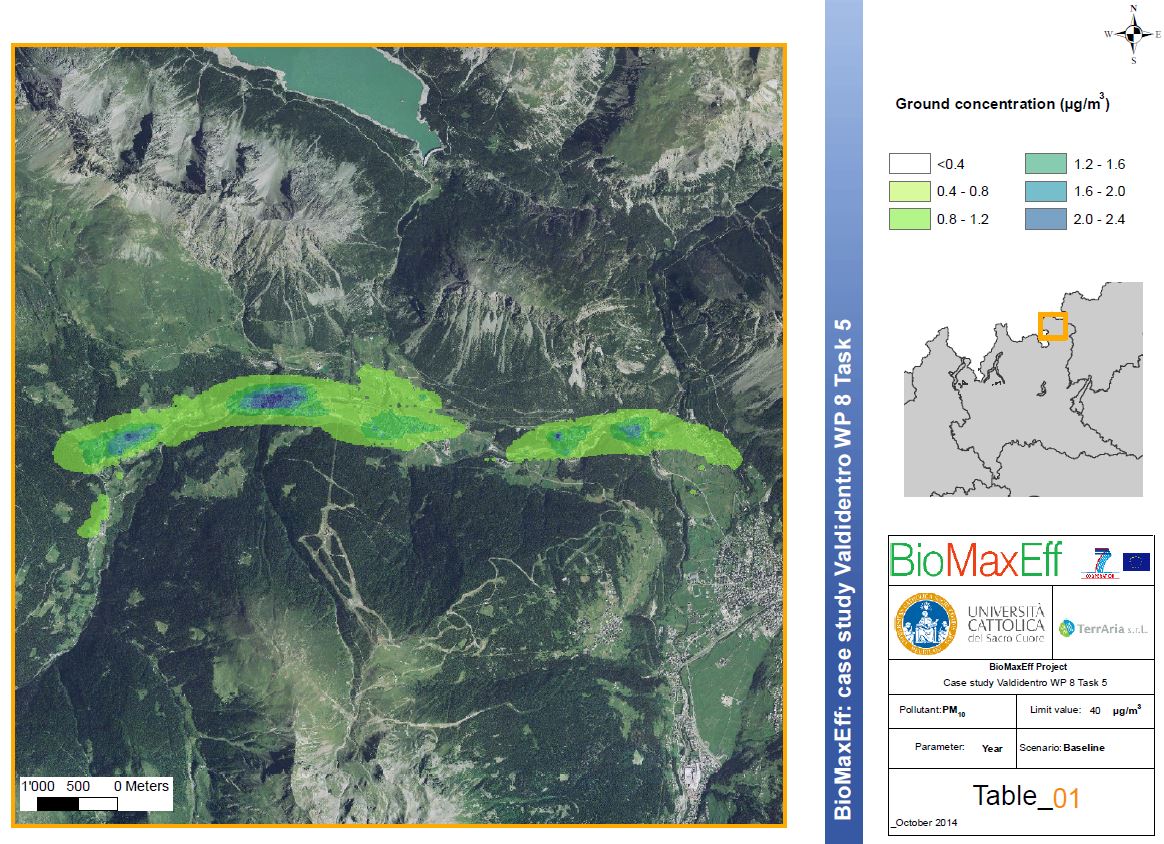
Emission scenarios were also developed for representative European case studies in alpine and rural areas, with air quality modelling carried out using the CALPUFF dispersion model. Results show that replacing traditional technologies with innovative pellet systems can lead to air quality improvements ranging from 5% to 25%, depending on the territorial context and pollutant considered.
THE ROLE OF TERRARIA
TerrAria was responsible for assessing the impact of these technologies at the European scale, both in terms of emissions and atmospheric pollutant concentrations, through high-resolution spatial and temporal modelling of emission scenarios. It also carried out simulations of air quality impacts at both local and European levels using an integrated multiscale approach, including experimental validation of the results obtained across different European application contexts.