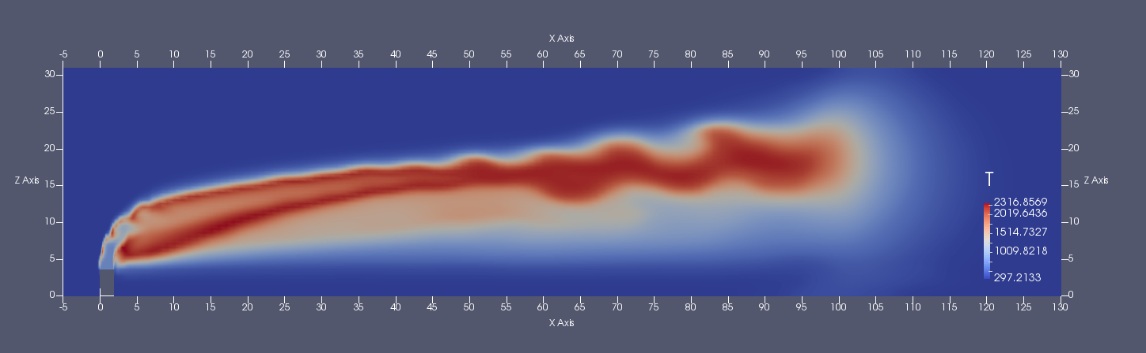
Reconstruction of the combustion process in a flare system
Within the field of micro-scale modelling, TerrAria was involved in a study aimed at reconstructing in detail the behavior of an industrial flare at the Versalis Brindisi plant during an operating phase characterized by high flare gas flow rates using a CFD model. The Versalis S.p.A. plant in Brindisi extends over an area of 3 km² and is located within the petrochemical complex in the Pedagne area, included in the perimeter of the Brindisi National Site of Interest. The micro-scale approach made it possible to address the problem with a level of detail sufficient to analyze combustion, flame formation and the associated turbulent flows with a degree of precision consistent with the complexity of the plant.
The main tool used was OpenFOAM, an open-source CFD model widely established in both academic and industrial contexts. The reactingFoam solver, dedicated to modelling combustion processes with chemical species transport, was selected to simulate the mixing between flare gas and ambient air and to reproduce the three-dimensional structure of the flame.
Its flexibility made it possible to handle particularly demanding operating conditions, typical of a flare terminal equipped with a smokeless system, in which the injection of steam or auxiliary air promotes the complete oxidation of compounds and prevents the production of visible smoke.
The simulation was conducted by building a three-dimensional domain capable of containing the entire development of the flame, with a discretization suitable for capturing both the jet behavior and the turbulence generated by the mixing system. Conservative emission parameters were adopted, based on the maximum recorded flow rate and on the most unfavorable gas composition in terms of potential emission of critical compounds, thus ensuring that the modelling represented a conservative scenario.
The CFD model made it possible to obtain an accurate representation of the flame, its height and spatial extension, temperature fields, turbulent motions and the presence of any unburned compounds. The results highlighted high combustion efficiency values, exceeding 99.2%, consistent with the performance of industrial flare systems designed to ensure intense combustion even under complex operating conditions.
A central element of the study was the connection between micro-scale modelling and dispersion modelling. Emission conditions — temperature, velocity, composition and the actual geometry of the plume — are in fact essential inputs for local-scale models (such as CALPUFF) when realistic and coherent data are required. The use of CFD makes it possible to overcome the approximations typical of standard parameters, providing a description that more closely reflects the actual behavior of the source and improving the quality of subsequent assessments in terms of ground-level concentrations and potential receptor exposure.
THE ROLE OF TERRARIA
Within this activity, TerrAria managed the entire modelling process, from defining the operating conditions to configuring the simulation and interpreting the results. The work required consolidated expertise in the management of CFD model, the representation of turbulent flows and the modelling of combustion phenomena under highly variable thermal and dynamic conditions.
TerrAria designed the computational domain, built the geometry of the flare terminal and the combustion support devices, generated the computational grid and configured the physical models required to reproduce combustion and mixing processes. Once the simulation was completed, the analysis addressed not only the energetic and fluid-dynamic aspects but also the emission-related aspects, with particular attention to the variables necessary to characterize the origin of the plume.
The results obtained made it possible to describe in detail the behavior of the flare during the emission event, providing the plant with useful elements for understanding the performance of the system, verifying its operation and obtaining reliable parameters for subsequent dispersion assessments.
This activity demonstrated how micro-scale CFD modelling can become a decisive tool when complex and strongly localized phenomena need to be represented, providing advanced technical support for decision-making processes, environmental analyses and the operational management of industrial plants.