Integrated Air Quality Assessment in Emilia-Romagna
RIAT+ (Regional Integrated Assessment Tool Plus) is an integrated modelling system designed to assess the impacts of atmospheric emissions and to define emission reduction scenarios consistent with air quality objectives. It was developed to support technical experts and public decision-makers in environmental planning processes.
Originally created within the framework of the European OPERA project (LIFE09 ENV/IT/000092), the tool enables quantitative analysis of the relationship between emission sources, mitigation measures and the response of air quality indicators.
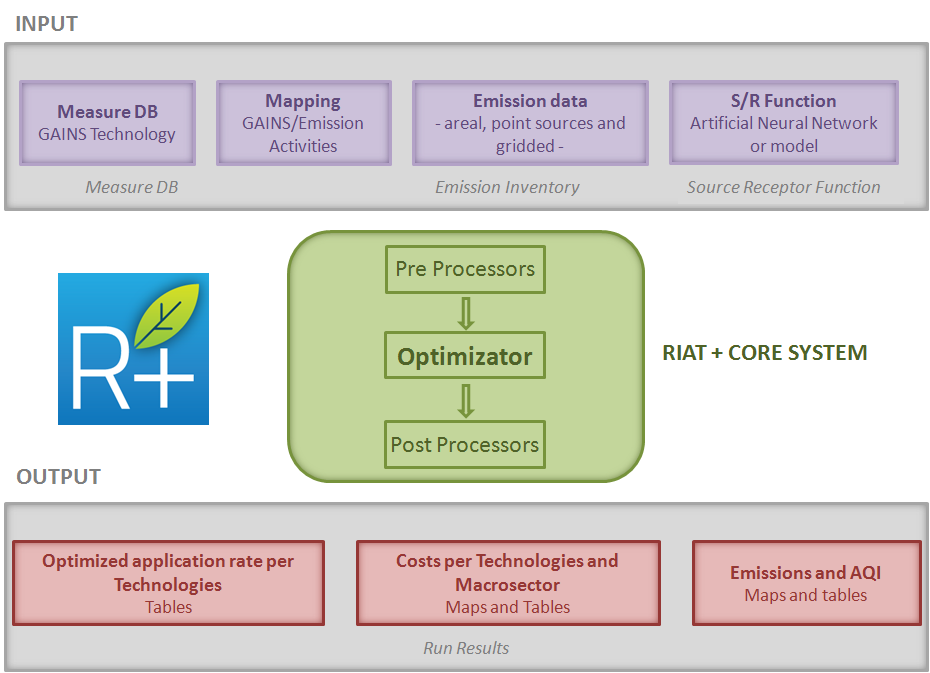
From an operational perspective, the system provides two distinct decision-making pathways. The first, referred to as scenario analysis, allows users to evaluate the effects resulting from the implementation of specific policies or technologies. The second, based on optimisation procedures, identifies the most efficient combinations of measures according to environmental targets and economic constraints.
Within the tool, the relationship linking emissions to Air Quality Indicators (AQIs) is described through Source/Receptor (S/R) models. In order to limit computational time, RIAT+ uses non-linear relationships identified through Artificial Neural Networks (ANNs), trained to replicate the results of a limited set of simulations carried out by users with deterministic air quality models.
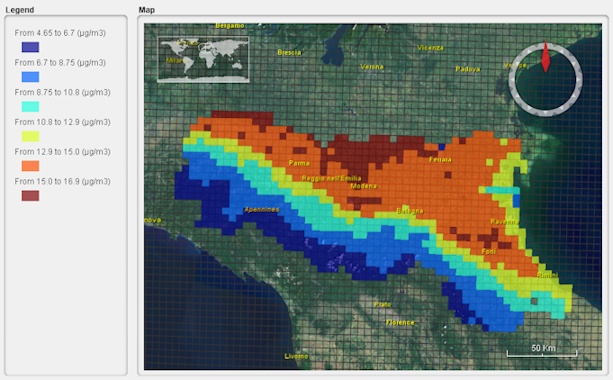
The main outputs of RIAT+ include quantification of emission reductions over the domain, a table reporting application rates for each technology used (i.e. the degree of diffusion or penetration of a technology), maps of key air quality indicators (AQIs), and the Pareto Curve, which provides the most efficient implementable solutions as costs vary (in optimisation mode). These results support comparison between alternative scenarios and facilitate identification of the most effective policies.
RIAT+ has already been tested and applied in several European regions for different specific objectives. In Emilia-Romagna, it was applied in “optimisation” mode to assess the effectiveness of both technical and non-technical measures included in the regional air quality plan.
In December 2014, the Emilia-Romagna Region, through the Regional Environmental Protection Agency (ARPAE), launched an integrated technical support project for the development of the Regional Integrated Air Plan (PAIR2020). The methodological core of this activity was the application of the integrated modelling system.
The regional territory is characterised by marked geomorphological heterogeneity, including valleys, hilly areas, mountainous zones and a significant portion of the Po Valley, where wintertime air stagnation frequently leads to elevated concentrations of pollutants such as PM10 and NO₂. This geographical complexity, combined with diverse anthropogenic sources, required the adoption of an integrated modelling system to understand and manage air pollution.
The case study was designed to address three strategic questions:
- determine the magnitude of emission reductions required to achieve the air quality targets set by PAIR2020;
- identify the optimal combinations of technical and non-technical measures capable of achieving these reductions;
- assess the technical and temporal feasibility of meeting environmental targets through policy measures.
The analysis relied on a structured set of data and tools:
- the regional INEMAR emission inventory, providing detailed estimates of emissions by sector and source type;
- the mapping between GAINS emission categories and the SNAP classification used by INEMAR, necessary to integrate measures defined at European level into the local context;
- a comprehensive database of reduction measures, including more than 2’200 technical and non-technical actions, each characterised in terms of efficiency, applicability, costs and implementation factors;
- the definition of emission reduction scenarios.
- The estimated emissions were used as input to an integrated modelling system based on the NINFA chemistry-transport model, capable of simulating pollutant dispersion at regional scale.
The results highlighted:
- significant emission reductions in the sectors most responsible for exceeding air quality limit values, particularly transport and agriculture;
- the need for structural and coordinated interventions, such as mobility management, energy efficiency improvements and the adoption of lower-emission technologies;
- the effectiveness of the neural engine integrated in RIAT+ in representing non-linear relationships between emission reductions and atmospheric concentrations, providing robust environmental decision-making support.
THE ROLE OF TERRARIA
Within this project, TerrAria played a key role as a technical-scientific partner, contributing to the development, application and interpretation of RIAT+ system results. In particular, TerrAria supported:
- integration between regional emission inventories and integrated assessment systems;
- development and validation of emission reduction scenarios;
- critical analysis of modelling outputs to environmental decision-making support.
Through its modelling expertise and in-depth knowledge of the territorial context, TerrAria helped transform RIAT+ into a concrete instrument for environmental policy support, promoting data-driven and scientifically robust decisions. This case study represents an example of how technical-environmental consultancy can effectively contribute to air quality planning and public health protection.