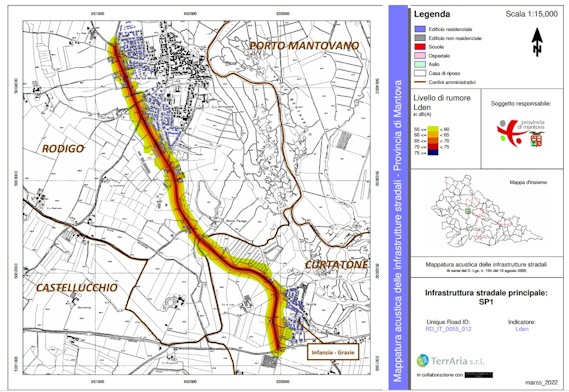
Assessment of the impact of road traffic noise emissions in the Province of Mantova
The Noise Mapping of the Province of Mantova was developed in compliance with Legislative Decree 194/2005 and subsequent amendments and additions, as updated by Legislative Decree 42/2017, with the aim of analysing and representing the impact of road noise emissions generated by vehicular traffic along the main infrastructures under provincial responsibility. The intervention covered all major roads characterised by traffic volumes exceeding 3 million vehicles/year, providing a coherent and comprehensive territorial-level framework of the relationship between road noise emissions and the spatial areas affected, in order to define noise mitigation strategies.
Noise Mapping applies to urban agglomerations with more than 100’000 inhabitants and to major roads with more than 3’000’000 vehicles per year, major railway lines with more than 30’000 train movements per year, and major airports with more than 50’000 movements per year.
The Province of Mantova is located in the south-eastern part of Lombardy and borders the Veneto and Emilia Romagna Regions. It comprises 64 municipalities, covering a total area of approximately 2’341 kmq and a population of 406’061 inhabitants (ISTAT 2021).
The road network under study includes 18 infrastructures under provincial responsibility, with a total length of approximately 128 km.
The Noise Mapping activity was developed in accordance with the most recent European CNOSSOS-EU methodologies, ensuring results that are consistent, comparable and aligned with current EU standards.
For each infrastructure, road noise emissions were estimated based on dedicated traffic monitoring campaigns carried out using fixed automatic instrumentation and mobile devices positioned on each traffic lane. Both technologies enabled vehicle classification by category and measurement of travel speed; the data were subsequently aggregated by time periods and vehicle categories.
Modelling simulations were performed using the professional SoundPLAN software, a reference tool for environmental noise modelling at territorial scale.
The acoustic descriptors used, as required by Legislative Decree 194/2005, are:
- Lden – average sound level over the entire day;
- Lnight – average sound level during the night-time period only.
The project produced noise maps describing the acoustic climate of the provincial territory through geometric representations of Lden and Lnight levels, providing an overview of traffic noise propagation and enabling quantification of the number of people, dwellings and sensitive buildings (such as schools and public facilities) exposed to specific noise classes.
The data were processed within a GIS environment, allowing detailed analyses and supporting planning decisions regarding noise mitigation measures.
Based on the results of the Noise Mapping, potential noise mitigation measures within the territory were identified, including:
- traffic management measures on the road network;
- maintenance of road surfaces to reduce additional noise emissions caused by deteriorated pavements;
- design of new roundabouts and installation of speed control devices to improve traffic flow and reduce noise at source;
- use of noise-reducing pavements on high-speed extra-urban sections;
- intervention programmes for school buildings aimed at improving passive acoustic performance in the most exposed areas.
The Noise Mapping of the Province of Mantova represents a strategic tool to support noise remediation policies, safeguard public health and quality of life, and provide local authorities with a technical basis for territorial and infrastructure planning.
The outputs were transmitted to the Ministry in accordance with the standards set out in Directive 2002/49/EC.
THE ROLE OF TERRARIA
The company contributed to the Noise Mapping process for the provincial road network of Mantova, supporting the public authority in data collection and analysis, acoustic modelling and cartographic reporting. Its technical expertise in environmental acoustics supported the administration in territorial planning and in defining noise mitigation and acoustic remediation measures across the territory.