
Sustainable Energy and Climate Action Plan of the Brianza Ovest Municipalities
In May 2021, the municipalities of Barlassina, Bovisio Masciago, Cesano Maderno, Lentate sul Seveso, Meda, Seveso, and Varedo decided to join together within the macro-area “Brianza Ovest” and jointly sign the commitment of the Covenant of Mayors for Climate and Energy. Through this initiative, they voluntarily committed to reducing their CO₂ emissions in an integrated way beyond the 55% target by 2030, compared with a shared reference year, while also sharing a long-term vision for 2050: accelerating the decarbonization of their territories, strengthening the capacity to adapt to climate change, and ensuring that citizens have access to secure, affordable, and sustainable energy.

The SECAP of Brianza Ovest stems from the desire of the municipalities of Barlassina, Bovisio Masciago, Cesano Maderno, Lentate sul Seveso, Meda, Seveso and Varedo to work together in an integrated manner, with the aim of achieving a broader vision and a greater impact on the sustainable development of the region
The commitment undertaken by the Brianza Ovest municipalities includes:
- Reducing CO₂ emissions by at least 55% across the entire macro-area by 2030, compared to the BEI reference year (2005), particularly through improved energy efficiency and increased use of renewable energy sources;
- Strengthening resilience, enabling the territory and the community to adapt to the effects of climate change;
- Supporting citizens in accessing secure, sustainable, and renewable energy;
- Sharing their vision, results, experience, and know-how with other local and regional authorities across the EU and beyond through direct cooperation and peer-to-peer exchange, particularly within the framework of the Global Covenant of Mayors.
The Covenant of Mayors is supported by three pillars (mitigation, adaptation, and energy poverty) through which the objective can be achieved of enabling all European citizens by 2050 to live in climate-neutral, decarbonized, and resilient cities, with access to secure, affordable, and sustainable energy, while actively participating in the climate transition process.
The SECAP document therefore includes, in addition to the cross-cutting theme of energy poverty, three main components:
- The municipal inventory of energy consumption and CO₂ emissions – BEI (Baseline Emission Inventory) and the subsequent MEI (Monitoring Emission Inventories), together with the framework of risks and vulnerabilities affecting the municipal territory;
- The Action Plan for territorial decarbonization (Mitigation);
- The Action Plan for Adaptation.
The analytical work for drafting the SECAP begins with an analysis of the context of the individual municipalities within the Brianza Ovest macro-area, which is then integrated into a unified framework to enable an overall perspective capable of supporting more effective and coordinated sustainable territorial development planning.
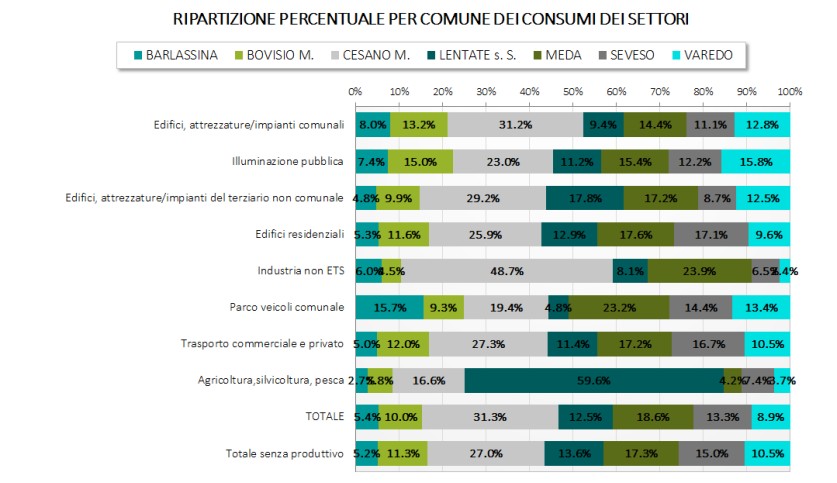
Analyzing macro-area consumption in the BEI year, the residential sector emerges as the most energy-intensive sector, with natural gas as the predominant energy carrier. Regarding emissions, the residential sector remains dominant, while the main energy carrier is electricity.
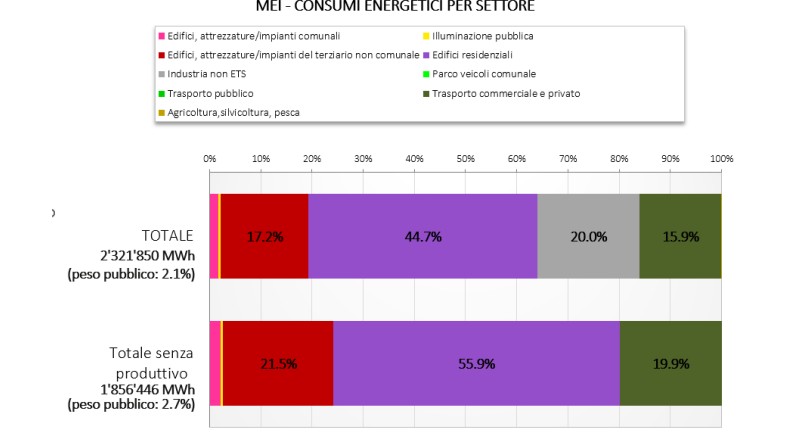
In the MEI year, the situation is similar: the residential sector remains the dominant contributor to both consumption and emissions, while the main energy carrier is natural gas in both cases. Comparing the two reference years, energy consumption increases, while emissions decrease, partly due to the reduction in the emission factor of electricity. The SECAP reduction target is calculated on a per capita basis, excluding the industrial sector.
To achieve the reduction target, three types of actions have been identified:
- Trend-based actions;
- “Territorial” actions, namely actions that must be implemented by the Brianza Ovest municipalities according to their respective responsibilities;
- Public sector actions, consisting of specific actions derived from materials provided by the Municipal Administrations.
These actions are aimed at reducing energy consumption through improvements in the energy efficiency of the existing building stock, replacing obsolete technologies with more efficient boilers and appliances, and increasing the installation of renewable energy sources, such as the creation of a Renewable Energy Community (REC), which represents a potential tool for addressing the issue of energy poverty.
The adaptation section highlights the risks and vulnerabilities affecting the macro-area territory and aims—through knowledge dissemination, citizen engagement, and awareness-raising—to increase the capacity to respond to climate change.
THE ROLE OF TERRARIA
TerrAria contributed to the analysis of the individual datasets of the different municipalities, harmonizing them and developing the integrated inventory of energy consumption and emissions for the Brianza Ovest macro-area, combining local datasets with regional and national databases. TerrAria supported the Municipal Administrations in identifying the emission reduction target and the strategies required to achieve it, allowing each municipality to contribute according to its specific share of energy consumption and emissions. Through territorial analysis, TerrAria also highlighted the issue of energy poverty, identifying reference indicators and proposing the first tools to address the problem, with the aim of ensuring fair access to energy for all citizens.