Sustainable Energy and Climate Action Plan of the Municipality of Brescia
The Municipality of Brescia approved the Sustainable Energy and Climate Action Plan (SECAP) on 24/05/2021. The SECAP of the Municipality of Brescia includes two central components and a cross-cutting element related to energy efficiency and the increased use of renewable energy sources:
- Mitigation (an objective already included in the SEAP) – the reduction of CO₂ emissions (decarbonization of territories);
- Adaptation (a new objective introduced with the SECAP) – the reduction of risks related to climate change.
The SECAP is composed of three sections: the municipal inventory of energy consumption and CO₂ emissions (BEI – Baseline Emission Inventory), including the framework of risks and vulnerabilities affecting the municipal territory; the Action Plan for decarbonization; and the Action Plan for adaptation.
For the Municipality of Brescia, the emission reduction by 2030 target was calculated with the BEI set to 2010, excluding emissions from the industrial sector, and expressed per capita. Through the actions included in the SECAP of the Municipality of Brescia, it is possible to reach and exceed a 50% reduction target in per capita emissions.
In particular, an increase in emissions of approximately 25’072 tonnes was estimated, and it was assumed that by 2030 total emissions will amount to approximately 646’371 tonnes (excluding the industrial sector), assuming that emissions related to the existing building stock remain unchanged compared to the BEI. The emission reduction by 2030 has therefore been estimated at approximately 312’400 tonnes.
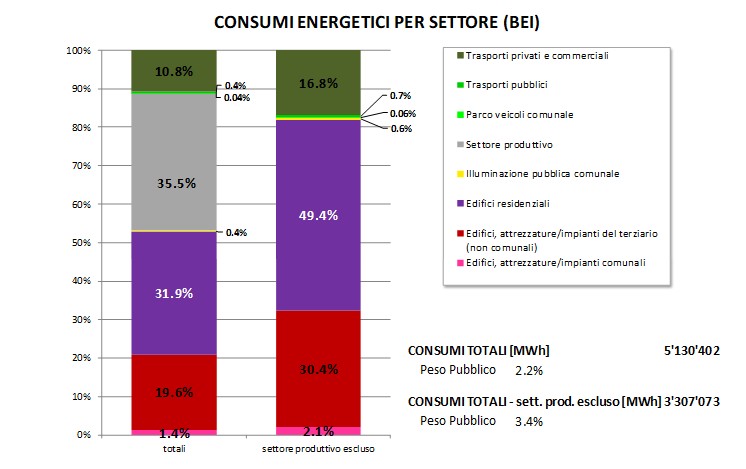
The municipal consumption inventory highlights that the residential sector is responsible for the largest share of emissions, followed by the tertiary sector and transport. In terms of energy carriers, the most representative within the consumption context is district heating, accounting for about one third of total consumption in 2010.
Emissions show a similar distribution to consumption: the residential sector remains predominant, followed by the tertiary sector and transport. The energy carrier responsible for the largest share of emissions is electricity, followed by district heating.
The mitigation actions identified by the SEAP aim to reduce energy consumption, increase the use of renewable energy sources, and improve the energy efficiency of buildings and technologies.
The sector where efforts must be primarily focused—besides the municipal tertiary sector, where energy efficiency improvements are planned for buildings and public lighting—is the residential sector, where the following actions are planned:
- Improvement of the building envelope;
- Replacement of heating systems with more efficient technologies in order to reduce emissions and increase energy savings;
- Replacement of appliances and light bulbs to reduce energy consumption;
- Installation of renewable energy sources.
A crucial element throughout the SECAP process is the involvement of citizens and the promotion of awareness toward more responsible and environmentally sustainable lifestyles, not only with regard to housing but also in relation to sustainable mobility.
The section dedicated to climate adaptation, in synergy with the Climate Transition Strategy, identified the main environmental hazards associated with climate change and the related risks. Based on the analysis of the situation, specific actions were identified.
THE ROLE OF TERRARIA
TerrAria supported the Municipal Administration of Brescia in the preparation of the reference energy and emissions inventories for the SECAP of the Municipality of Brescia—specifically 2010 and 2018—starting from the collection of consumption data for municipal buildings, public lighting, municipal transport, and public transport services.
TerrAria integrated the municipal databases with the available regional and national databases, thereby constructing a municipal framework as closely aligned as possible with the actual context of Brescia. Based on this framework, it contributed to identifying targeted actions aimed at reducing CO₂ emissions and achieving the SECAP objective of emission reductions by 2030. With regard to climate change adaptation, again in synergy with the Municipal Administration, TerrAria prepared a framework of territorial risks and sensitivities and provided support in drafting specific actions in this area as well.