
Starting from 2026, updated data for 2023 from the Lombardy emissions inventory (INEMAR – INventario EMissioni ARia) are available. The inventory provides a quantitative estimate of atmospheric emissions generated both by anthropogenic sources (such as traffic, heating, and industrial activities) and natural sources (for example forests), analyzing their distribution across the regional territory.
INEMAR divides emission sources into 11 macro-sectors:
1 – Energy production and fuel transformation
2 – Non-industrial combustion
3 – Industrial combustion
4 – Production processes
5 – Extraction and distribution of fuels
6 – Use of solvents
7 – Road transport
8 – Other mobile sources and machinery
9 – Waste treatment and disposal
10 – Agriculture
11 – Other sources and absorptions
Updates compared to the 2021 edition
The new edition of the inventory introduces methodological improvements that increase the precision of estimates and reduce uncertainty in the results. The main updates include:
- In the assessment of emissions from the livestock sector, data from over 700 intensive farms subject to IEA (Integrated Environmental Authorization) were integrated. For activities not subject to IEA, Lombardy-specific emission factors were defined, resulting in a decrease in estimates of about 14% compared with those based on national average values. In addition, the manure spreading phase was analyzed separately.
- For road traffic, the contribution of resuspension to PM10 emissions was also considered, the so-called “non-exhaust” component, which is an increasingly significant share of PM10 emissions not related to engine combustion. This source accounts for about 7.9% of total PM10.
- Emissions of dust from construction activities were also introduced in macro-sector 4.
- The estimate of emissions from pizzerias was improved thanks to a study by the University of Milan, which provided new emission factors based on experimental analyses and new methodologies for estimating activity indicators.
- Finally, several contextual elements were also considered, such as the presence of open fireplaces in residential buildings and the economic trend during the 2022–2023 period, characterized by rising prices of gas, pellets, and fertilizers. This influenced emission assessments, assuming greater use of biomass for heating and a reduction in the use of urea.
Main results of the INEMAR 2023 inventory
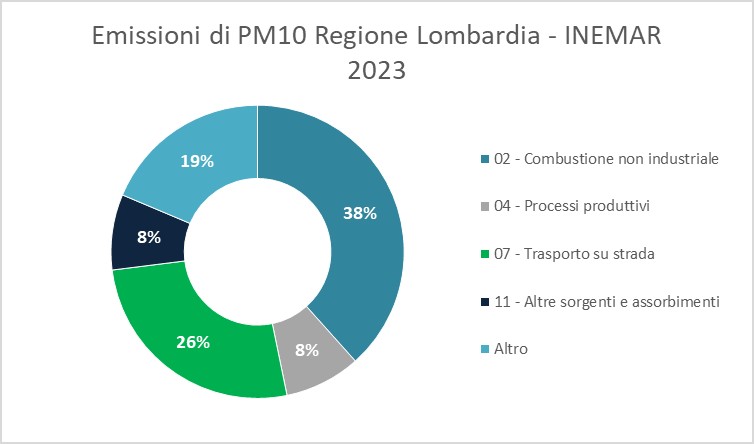
Particulate matter (PM10): in Lombardy, total PM10 emissions amount to 16’735 t/year. The main sources of primary PM10 are non-industrial combustion (38%), mainly due to the combustion of wood and similar fuels, and road transport (26%), where the largest contribution is related to wear and resuspension. These are followed by production processes (8.4%) and emissions from other sources and sinks (8.3%).
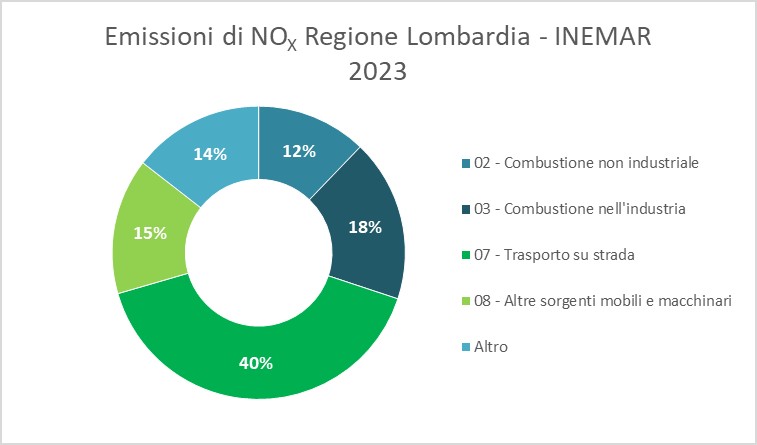
Nitrogen oxides (NOX): total regional NOX emissions amount to 82’700 t/year. The main source is road transport (40%), followed by industrial combustion (18%), particularly related to the use of industrial methane boilers and production processes in the cement and secondary aluminum sectors. Another significant share of emissions comes from other mobile sources (15%), including off-road agricultural machinery powered by diesel and air transport. Non-industrial combustion contributes 12%, mainly due to domestic heating with natural gas and the use of wood and other biomass for heating.
TerrAria’s contribution
The availability of updated and increasingly accurate emission data represents a key element for defining effective emission reduction measures and improving environmental planning.
TerrAria maintains a constant commitment to staying up to date on air quality issues, a core area of expertise for the company. Activities range from the preparation of environmental impact studies to support in the definition and development of air quality plans, with the objective of providing services that remain aligned with the evolution of the regulatory framework.
In this context, TerrAria contributed to the drafting of the Regional Plan of Air Quality Interventions of Lombardy Region, which uses the INEMAR emissions inventory as its main knowledge base.
TerrAria has also been contributing for years to the IT development of the INEMAR platform, dealing with the design of the architecture, database management, and the update of the INEMAR plus graphical interface dedicated to technical experts who are signatories to the interregional agreement for the development of their respective regional emissions inventories.