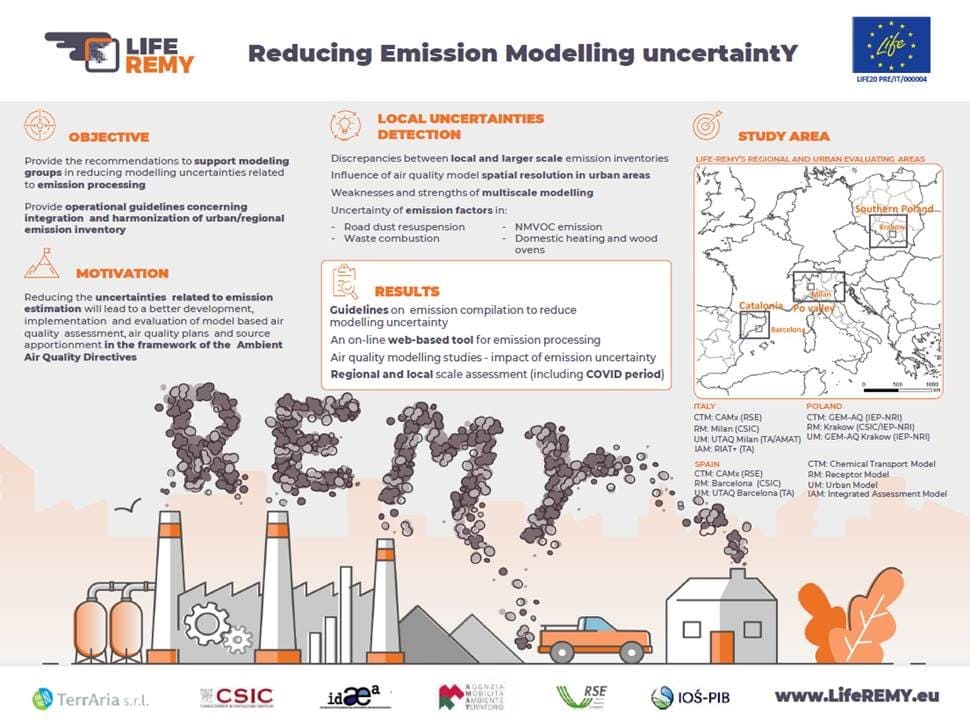
Air quality: Reducing Emission Modelling uncertainty
The REMY project (acronym for Reducing Emission Modelling UncertaintY) is framed within the context of European air quality legislation (Ambient Air Quality Directives), which requires Member States to assess and manage air quality through advanced tools, including environmental modelling. These models are essential for evaluating the measures to be applied within a given territorial context.
Their reliability strongly depends on the ability to accurately represent the spatial and temporal variability of pollutants. In this context, uncertainties related to model formulation, meteorological conditions, spatial resolution, and especially emission inventories represent a critical factor.
In particular, a significant share of the overall uncertainty derives from the quality of emission data, including inventory compilation methods (top-down and bottom-up), the emission factors used, the chemical speciation of pollutants, and the representation of temporal variability in anthropogenic activities.
REMY addresses these challenges through a detailed quantitative analysis based on modelling and simulations conducted both at the regional level in three critical European areas (Po Valley – IT, Catalonia – ES, Southern Poland – PL) and at the urban level in the cities of Milan, Barcelona, and Krakow.
The main objective of the project is to provide updated, comprehensive, and harmonised recommendations to support modelling groups in reducing modelling uncertainties, thereby contributing to improved development, implementation, and analysis of air quality assessment, air quality plans, and source apportionment within the framework of the Ambient Air Quality Directives.
Through dedicated simulations in the three EU contexts, the project assessed the impact of uncertainties in emission inventories and air dispersion models that may negatively affect air quality planning, both at regional and local scales, potentially leading to the identification of ineffective emission reduction strategies.
To this end, the project combines different modelling approaches, including chemistry transport models (CTM) such as CAMx, urban modelling such as UTAQ, and source apportionment techniques, to provide an integrated analysis of the main emission sources and their effects.
Within the project, a web tool was also developed to facilitate access to and use of emission inventories. Among its main features, the tool allows users to download high-resolution emission datasets at the European scale, as well as to upload and integrate user-specific emission data.
The data made available through the portal are based on the EMEP emission inventory (years 2017 and 2019) at three resolutions (0.025°, 0.01°, 0.005°), covering major air pollutants such as BaP, PM10, PM2.5, NOX, NVOC, SOX, and NH3.
| Project type: LIFE Preparatory Project, Grant Agreement n. LIFE20 PRE/IT/000004, European Union Budget: 1’538’414 Euro (923’048 Euro EU-funded), 432’922 Euro managed by TerrAria Duration: 2021 – 2024 Number and Partners involved: 5 project partners: TerrAria Srl (TA), Agenzia Mobilità Ambiente e Territorio Srl (AMAT), Consejo Superior de Investigaciones Científicas (CSIC), Institute of Environmental Engineering- National Research Institute (IEP-NRI), Ricerca Sistema Energetico (RSE) Role: Coordinating beneficiary Project website: liferemy.eu |
 |
The project focused on reducing the most relevant modelling uncertainties related to emission processing, with the aim of providing operational guidelines concerning:
- The integration and harmonisation of local/regional emission inventories, also through an online web-based application;
- Emission estimates for the most uncertain sources such as (I) road traffic resuspension emissions, (II) residential solid fuel combustion and pizzerias, (III) open burning of waste, also incorporating feedback from the modelling component;
- Modelling of emission and formation processes related to the generation of primary and secondary organic particulate matter;
- Multiscale modelling in urban and peri-urban areas, including both CTMs and local-scale modelling, as well as spatially variable resuspension processes.
Finally, the project integrates different modelling approaches and emission scenarios, including those derived from the COVID-19 period, to quantify the impact of uncertainties and support more effective decision-making in environmental policies. In particular, the comparison between baseline scenarios (Current Legislation) and actual emission reduction scenarios allows for the assessment of model sensitivity and the improvement of modelling performance indicators, such as the Modelling Quality Indicator (MQI) and the corresponding Modelling Quality Objective (MQO), thereby strengthening the decision-making process in air quality policies.
THE ROLE OF TERRARIA
Within the project, TerrAria is responsible for the sensitivity analysis of urban modelling in both baseline and COVID-19 scenarios, as well as for the development of guidelines and recommendations supporting the compilation of emission inventories. In addition, as project coordinator, TerrAria was responsible for the overall project management.